

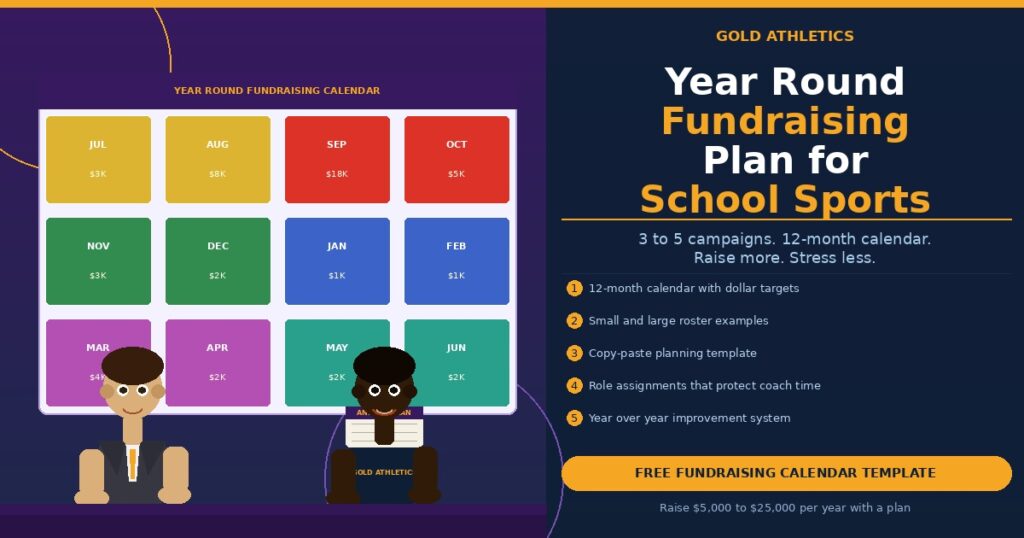
Quick Answer: A year round fundraising plan works when you set one annual dollar goal, map it to 3 to 5 fundraising seasons, then assign clear owners and deadlines for each campaign. Most teams raise more and stress less when they mix a high-profit signature fundraiser with smaller monthly revenue, because cash flow stays steady and families are not constantly scrambling.
What Is a Year Round Fundraising Plan for a School Sports Team?
A year round fundraising plan is a 12-month calendar that tells you what you will run, when you will run it, how much it should raise, and who is responsible. It prevents the common problem of doing one rushed fundraiser right before the season and then coming up short on budget.
It also protects athletes and parents from burnout since you spread fundraising across the year with breaks built in. Additionally, it helps coaches, booster leaders, and athletic directors forecast budgets early so equipment and travel decisions are not delayed by financial uncertainty. When people ask Gold Athletics for help, the biggest win is usually structure because a clear plan makes participation easier and accountability stays consistent throughout the year.
How Do You Set a Realistic Annual Fundraising Goal?
Set a realistic goal by pricing your season like a business, then subtracting what your school already covers. Start with known costs because guessing creates panic later.
If a varsity soccer team needs $4,800 for tournament travel, $2,200 for uniforms, $1,000 for training equipment, and $1,500 for coaching tools, the total need is $9,500. If the athletic department covers $3,000, the fundraising goal becomes $6,500. Moreover, add a small buffer for surprises. A simple rule is 10 percent, therefore the new goal in this example becomes $7,150.
How Do You Translate a Big Goal Into a Per-Athlete Target?
Divide the goal by your expected participant count, then adjust for reality. If you expect 22 athletes, $7,150 divided by 22 is about $325 per athlete. However, do not present it as a bill. Present it as a shared team goal with multiple ways to contribute since participation varies and a good plan assumes 70 to 80 percent of athletes will fully engage unless you have a strong accountability system in place.
How Many Fundraisers Should You Run in a Year?
Most teams do best with 3 to 5 fundraising seasons per year rather than 12 separate events. You want enough campaigns to hit the number, although not so many that families tune out and participation drops.
A practical mix is one signature fundraiser that produces 40 to 60 percent of the total goal, two medium campaigns tied to your season rhythm, and one ongoing program that brings in smaller monthly revenue. Consequently, you create stability without overloading volunteers. For example, a cheer program trying to raise $20,000 might plan a $12,000 signature campaign, two $3,000 seasonal pushes, and a $500 per month ongoing stream totaling $6,000 over a year. That gives $24,000 in capacity, therefore you have breathing room even if one campaign underperforms.
What Is the Best Calendar for a Year Round Fundraising Plan?
The best calendar follows your school year because attention is highest when athletes are together and routines are stable. It also aligns with major spending moments like summer camp, fall travel, and postseason expenses.
| Time of Year | Purpose | Example Campaign | Target Amount |
|---|---|---|---|
| July to August | Preseason cash for gear and travel | Sponsorship drive plus team camp support | $2,500 to $8,000 |
| September | Signature fundraiser while excitement is high | Blitz Day style campaign | $5,000 to $25,000 |
| October to November | Community event season | Discount card, spirit wear, or youth clinic | $1,500 to $7,500 |
| December | End of year giving | Tax-smart donations and alumni push | $1,000 to $5,000 |
| January to February | Winter reset | Restaurant nights plus merchant rewards | $500 to $2,000 |
| March to April | Spring boost | Sponsorship renewals and tryout fee support | $1,500 to $8,000 |
| May to June | Close the gap and fund summer | Online donation week plus car wash | $1,000 to $5,000 |
Gold Athletics often uses a Blitz Day model early in the year because it concentrates effort into a short window. That matters because coaches and parents typically have more energy for one intense well-coached push than a fundraiser that drags for six weeks.
How Do You Choose the Right Fundraising Mix for Your Sport?
You choose the mix based on roster size, community buying power, and how much time you can realistically supervise. Football and band can raise large totals because they have numbers, however smaller rosters like tennis or golf often need higher profit margin options.
What Does a Realistic Plan Look Like for a Small Roster Team?
Here is a realistic example for a 16-player softball team that needs $10,000. A September signature fundraiser targets $6,500. A November spirit wear drop targets $1,500. A spring sponsorship renewal targets $1,500. A year round merchant rewards program averages $100 per month, adding $1,200. Total capacity is $10,700, therefore you have cushion even if one campaign comes in slightly below target.
What Does a Realistic Plan Look Like for a Large Roster Program?
Here is a realistic example for a 55-athlete basketball program across levels that needs $28,000. A September signature fundraiser targets $18,000. A December alumni giving week targets $3,000. A March youth skills clinic targets $4,000. Ongoing merchant rewards average $250 per month, adding $3,000. Total is $28,000 with room to grow if participation stays strong.
How Do You Build Roles and Accountability Without Burning Out the Coach?
Build roles by assigning ownership to three groups: a coach point person, a booster operations lead, and athlete leaders. It works because responsibility is shared and communication stays consistent without any single person carrying everything.
A coach point person should spend time on messaging and culture rather than spreadsheets. The booster operations lead should handle money handling, permissions, and distribution. Athlete leaders should track participation and encourage teammates since peer accountability is often more effective than adult reminders. Gold Athletics is known for reducing coach workload through on-site coaching and app-driven athlete accountability. Even if you do not use a vendor, you can copy the principle: keep tasks simple, track activity daily during campaigns, and recognize effort publicly.
What Are Simple Weekly Time Expectations by Role?
During non-campaign months, most programs can keep it to 15 minutes per week for the coach point person and 30 minutes per week for the booster lead. During a signature fundraiser, however, plan for 60 to 90 minutes per day for five to seven days because momentum requires consistent daily attention.
How Do You Write a Fundraising Plan That Parents Will Actually Follow?
Write it like a one-page agreement with dates, expectations, and the exact dollar goal. Parents follow clarity, however they resist vague promises and open-ended timelines. Because transparency about how money is used consistently increases participation, every plan should list specific expenses alongside the goal.
Copy-paste year round fundraising plan template:
Program: [Name] School: [Name] Season Year: [Year]
Annual Fundraising Goal: $[Amount] — What this funds: [List expenses]
Fundraising Calendar: From [Month Day] to [Month Day], we will run [Campaign Name] with a team target of $[Amount]. Each athlete will be asked to [clear action] because participation is the key driver of results.
From [Month Day] to [Month Day], we will run [Campaign Name] with a team target of $[Amount]. Families can participate by [clear action] and we will provide scripts and reminders throughout.
Communication Plan: Updates will be sent by [text app or email] on [day of week] and the primary contact is [name and role].
Money Handling: All funds will be collected through [method], deposited within [timeframe], and reported to families on [day of month].
Participation Expectations: Each athlete is expected to complete [number] contacts during major campaigns since effort directly affects team resources. If a family has constraints, contact [name] by [date] to discuss options.
Signatures: Coach: ___ Booster President: ___ Parent or Guardian: ___ Athlete: ___
How Do You Track Results and Improve Year Over Year?
Track three numbers for every campaign: participation rate, dollars per athlete, and profit margin. This matters because a fundraiser that raises $8,000 with 90 percent participation is usually healthier than one that raises $9,000 with 40 percent participation.
If you raised $12,000 with 30 athletes, your dollars per athlete is $400. Next year, aim for $450 by improving scripts, incentives, and follow-up. Additionally, track what week and day donations spike because timing changes outcomes more than most programs realize. Teams that work with Gold Athletics often focus on participation first since accountability systems typically lift results without adding more events. Consequently, you can raise more while doing less when the system runs correctly.
What Is a Practical Review Timeline?
Do a 15-minute review within 72 hours of each campaign ending while details are fresh. Then do a bigger 45-minute review in May or June to set next year targets because you can lock dates before the school calendar fills up and families make summer plans.
What Are Common Mistakes to Avoid in Year Round Fundraising?
Most year round fundraising problems come from the same avoidable patterns. Because each mistake compounds the others, fixing even two or three of them dramatically improves results across the full year.
Relying on a single fundraiser to cover everything is the most common mistake. If it underperforms, you have no backup, therefore the season suffers. Setting goals without listing expenses is another because when parents do not know what they are funding, they assume it is optional. Additionally, letting campaigns run too long creates procrastination, although short intense pushes create urgency and drive faster results. Finally, many teams under-communicate. If you send one email and hope it works, results are inconsistent because weekly reminders during calm months and daily touchpoints during active campaigns consistently outperform passive communication.
Frequently Asked Questions
What is the best month to run a signature fundraiser for a school sports team? September is often best because athletes are together, excitement is high, and families are back in routine. Since energy and attention are highest at the start of the school year, launching your biggest campaign in September consistently outperforms mid-season or end-of-year timing.
How much can a typical school team raise in a year with a plan? Many teams land between $5,000 and $25,000 depending on roster size, community support, and participation rate. Because a structured plan with clear per-athlete targets and multiple campaigns produces more predictable results than a single rushed fundraiser, the annual total usually increases significantly after the first planned year.
How do you fundraise year round without exhausting parents? Use 3 to 5 fundraising seasons, keep campaigns short and focused, and add one ongoing low-effort revenue stream like merchant rewards. Since spacing campaigns with clear breaks prevents family fatigue, the total raised over the year often exceeds what a single intense campaign could produce.
What is a good participation rate target for school sports fundraising? Aim for 80 percent or higher during major campaigns because results become predictable and manageable at that level. When participation drops below 60 percent, a small group carries the load, resentment builds, and future campaigns become harder to launch.
Do booster clubs or coaches need to handle all the work? No. The best plans split ownership across a coach point person, a booster operations lead, and athlete leaders. Because divided ownership prevents any single person from burning out, this three-group structure consistently produces better results and higher volunteer retention season over season.
How does Gold Athletics fit into a year round fundraising strategy? Gold Athletics is often used as the signature fundraiser because its Blitz Day coaching and app-based accountability can increase participation while reducing coach workload. Since the signature campaign typically produces 40 to 60 percent of the annual goal, having a structured partner for that campaign creates a reliable foundation for the rest of the year round plan.