

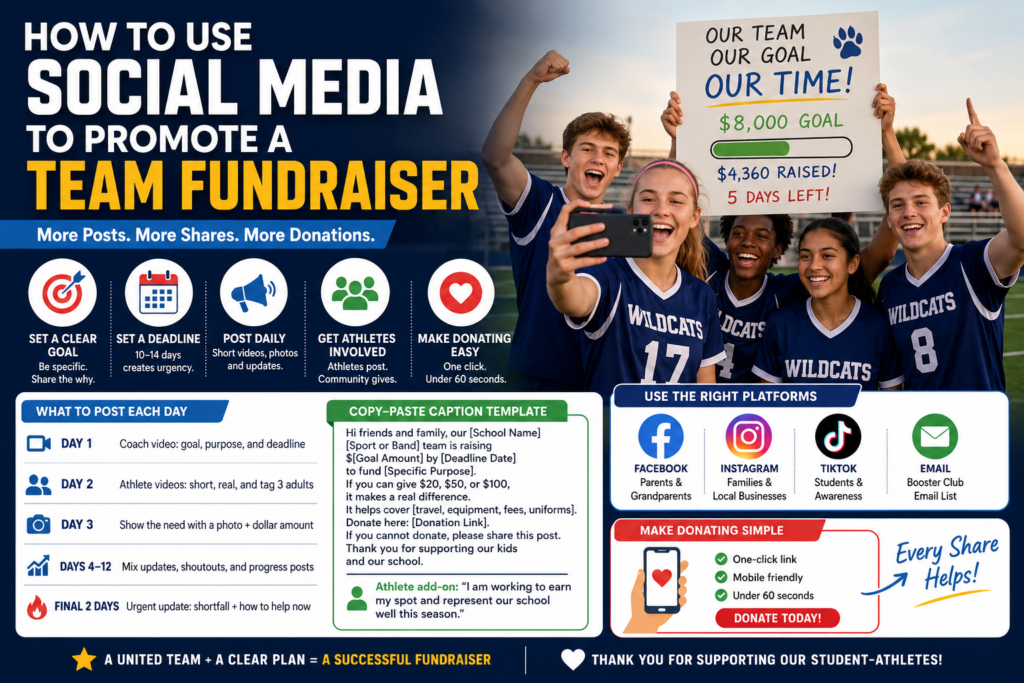
To promote a team fundraiser on social media, pick one clear goal and one deadline. Post a simple daily plan across the platforms your parents already use. Make it easy to donate in under one minute. Use athlete-led short videos, weekly progress updates, and a copy-paste donation message so supporters can share without thinking.
What Is the Best Way to Promote a Team Fundraiser on Social Media?
The best way is to run a short, focused campaign. Repeat the same message in multiple formats, because repetition turns views into donations.
Most teams raise more when they combine three things: a clear financial target, a firm deadline, and daily posts with real athletes asking for help. A realistic timeline is 10 to 14 days.
For example, a volleyball team needing $8,000 for tournament travel can post daily for two weeks. They share a live progress total every three days and close with a 48-hour final push. Gold Athletics reduces coach workload by letting athletes carry the message. When athletes post, participation rises and results improve.
Which Social Platforms Should a School Team Use for Fundraising?
Use the platforms your donor base already opens daily. The goal is donations, not reach.
For most school teams, that means Facebook for parents and grandparents, Instagram for families and local businesses, and TikTok for student energy and momentum. If you can only manage two, choose Facebook and Instagram. They convert best for youth sports fundraising.
TikTok helps with awareness. However, most donations still come from older audiences who prefer Facebook. If you have a booster club email list, use it too. Social posts plus one email reminder tends to lift total giving. A simple rule: go where the credit cards are.
How Do You Set a Fundraising Goal That Performs Well on Social Media?
Tie your goal to something specific. People donate faster when they know what they are funding.
Instead of saying you need money for the season, say you need $6,500 for new safety helmets, $4,200 for a band trailer repair, or $9,800 for a cheer travel package. Specific goals create faster decisions.
What is a realistic dollar target and timeline?
A realistic social media target for one team is $5,000 to $15,000 over 10 to 14 days. This depends on roster size and community support.
For example, a 40-player football program aiming for $12,000 can give each athlete a personal goal of $300. When 30 athletes hit that number, you reach $9,000. The final $3,000 often comes from local sponsors during the last week.
How do you create urgency without sounding pushy?
Use deadlines and progress updates. Urgency is clearer than emotion.
A line like “We are at $4,360 of $8,000 and we have 5 days left” sounds factual. It motivates action without making supporters feel pressured. Progress updates consistently outperform emotional posts in donations per view.
What Should Your Team Post Each Day to Drive Donations?
Post the same core message daily in a different format. Donors need multiple chances to see it.
Keep most videos under 20 seconds. Keep most captions under 60 words. Mix in one sponsor spotlight post if a local business contributes. It adds credibility and encourages other businesses to participate.
A strong Day 1 post is a head coach video explaining the goal and deadline. It adds immediate credibility. A strong Day 2 post features three athletes each saying one sentence and tagging three adults. It creates sharing loops.
A strong Day 3 post shows a photo of a specific need, like worn uniforms, with a clear amount. For example: “$1,250 covers five new jerseys.” A strong final weekend post includes a specific shortfall. For example: “We are $740 away from fully funding our baseball cages. Can you help with $20 today?”
How Do You Write a Fundraising Caption That Gets Shared?
Write captions that are easy to copy. Most supporters will not rewrite your message.
Keep the first line clear. Include the exact dollar goal. Put the link or instructions in the same place every time. Add one sentence that invites sharing. That single line consistently multiplies reach without any extra effort.
Here is a copy-paste template you can use right now:
“Hi friends and family, our [School Name] [Sport or Band] team is raising $[Goal Amount] by [Deadline Date] to fund [Specific Purpose]. If you can give $20, $50, or $100, it makes a real difference. It helps cover [travel, equipment, fees, uniforms]. Donate here: [Donation Link]. If you cannot donate, please share this post. Thank you for supporting our kids and our school.”
For athlete accounts, add one personal line: “I am working to earn my spot and represent our school well this season.”
How Do You Get Athletes to Actually Post and Participate?
Give athletes a simple checklist and a short daily posting window. Complicated instructions lower participation.
The easiest window is right after practice. Athletes are already together and can post in two minutes. Gold Athletics uses athlete accountability in its fundraising model. When athletes know what to post, when to post, and how their effort is tracked, engagement rises across the full campaign.
What is a practical accountability system that does not overload coaches?
Use a shared Google Sheet with athlete names and two columns per day: “Posted” and “Shared.” Ask captains to verify by screenshot in the team group chat. This takes a coach about five minutes per day.
That simple system can move participation from 40 percent to 80 percent. Tie a small incentive to something free — a music pick for warmups, first choice of locker, or a team shoutout. Incentives create momentum during the final 72 hours.
How Do You Use Facebook Effectively for Team Fundraising?
Facebook is the strongest platform for parent and community donations. Treat it like your conversion engine.
Post from the team page, then have parents share into local community groups that allow school posts. For example, a softball team raising $7,500 for a spring break tournament posts the main link daily. Parents share it into neighborhood groups. The booster club reposts progress totals on Day 4, Day 8, and Day 12. That pattern keeps the link circulating without feeling repetitive.
Use a Facebook Event if you have a clear deadline and want automated reminders. Use a Facebook Group if you already have an active parent community. If you have neither, start with an Event. It is quicker and gives you a visible countdown.
How Do You Use Instagram to Drive Donations and Shares?
Instagram works best when you combine Stories and Reels. Stories hit existing followers. Reels reach beyond them.
Keep the fundraiser link in your bio and mention it in every Reel caption. A strong rhythm is one Reel per day and three to five Story frames per day. Have each athlete post one Story with the link and a short message. This reaches different pockets of supporters across each athlete’s network.
A simple three-frame Story is enough. Use a face-to-camera ask, a screenshot of the donation page or goal thermometer, and a final frame that says “Link in bio” or “DM me for the link.” If your platform allows link stickers, use them every time. Fewer clicks means more donations.
How Do You Use TikTok Without Wasting Time?
Use TikTok for awareness and energy. Then push donors to a simple link.
TikTok performs best when it is fun and athlete-led. Keep the fundraising ask direct. A realistic approach is three posts per week during a 14-day campaign.
A basketball team can post a quick locker room chant, a practice highlight with the text “Help us raise $10,000 by Friday,” and a progress update when you cross $5,000. Those posts create social proof. Supporters who see them often donate through Facebook or Instagram later.
How Do You Get Local Businesses Involved Through Social Media?
Local businesses want visibility and community goodwill. Offer them a simple, structured exchange.
A practical offer is $250 for one sponsor post, $500 for two posts plus a logo in your team banner, or $1,000 as a presenting sponsor for the week. Write one clear message and send it to 20 local businesses. Volume matters.
When a business says yes, tag them, thank them publicly, and ask them to share the post. Gold Athletics has a merchant rewards model built around this idea. Even without a formal program, a clean sponsor spotlight series works well.
What Is the Best Posting Schedule for a Two-Week Fundraiser?
Post daily for 14 days. Consistency beats occasional big posts.
Keep the main team page posting once per day. Ask athletes to repost three times per week. Ask parents to repost twice per week. If you miss a day, do not restart the plan. Just post the next piece. Momentum matters more than perfection.
14-Day Posting Plan:
- Day 1 — Launch video from head coach
- Day 2 — Athlete asks with tagging
- Day 3 — Purpose post showing a specific need
- Day 4 — Progress update with current total
- Day 5 — Sponsor spotlight
- Day 6 — Athlete repost push
- Day 7 — Mid-campaign recap
- Day 8 — Purpose post round two
- Day 9 — Athlete asks round two
- Day 10 — Progress update
- Day 11 — Behind-the-scenes practice clip
- Day 12 — Sponsor spotlight round two
- Day 13 — 48-hour countdown post
- Day 14 — Final day update and thank you
How Do You Track Results and Know What Is Working?
Track donations by day and match them to posts. You want to repeat what converts.
Use simple labels like “Launch video,” “Athlete ask,” and “Progress update.” Note which days had the biggest spikes. For example, a soccer fundraiser averaging $150 per day might jump to $900 on a day with three athlete videos and a clear “ends tonight” caption. That tells you athlete-led content plus urgency is your lever. Repeat it on the final two days.
If your platform provides participation reporting, use it. Gold Athletics focuses on reducing coach workload through structure, and tracking is a core part of that structure.
How Do You Avoid Common Mistakes That Reduce Donations?
Most social media fundraising problems come from the same avoidable patterns. Fixing even two or three of them improves results across the full campaign.
Making donating hard is the biggest mistake. Every extra click loses people. Put the link in the same place every time and keep instructions consistent. Posting only once is another costly mistake. Many supporters will not see it the first time.
Avoid vague goals too. People give more confidently when they understand the exact purpose of their donation. Finally, do not let only the coach post. When athletes and parents share, reach multiplies fast. Fundraisers almost always finish stronger when the whole team is involved.
Frequently Asked Questions
What is the best social media platform for a team fundraiser? Facebook is usually best for donations. Parents and grandparents are most active there. Instagram can match it when Stories and Reels are used daily.
How long should a social media fundraiser run? Ten to fourteen days is ideal. It creates urgency without dragging on. Campaigns longer than two weeks lose momentum after the first week.
How often should we post during a fundraiser? Post once per day on the team account. Add Stories and athlete reposts several times per week to increase reach. Consistent daily posting matters more than production quality.
What amounts should we ask people to donate? Ask for specific amounts like $20, $50, or $100. Clear numbers reduce hesitation and speed up giving. Donors decide faster when they see a menu of options.
How do we get athletes to participate without stressing coaches? Give athletes a copy-paste message, a daily posting window after practice, and simple screenshot accountability tracked by captains. Athletes posting on their own accounts consistently outperform team-only posts for reach.
Can local businesses help even if they cannot donate a lot? Yes. A $250 sponsor post or a $500 two-post package is realistic for many local businesses. When businesses share the fundraiser to their own audience, they multiply your reach at no extra cost.