

Quick Answer
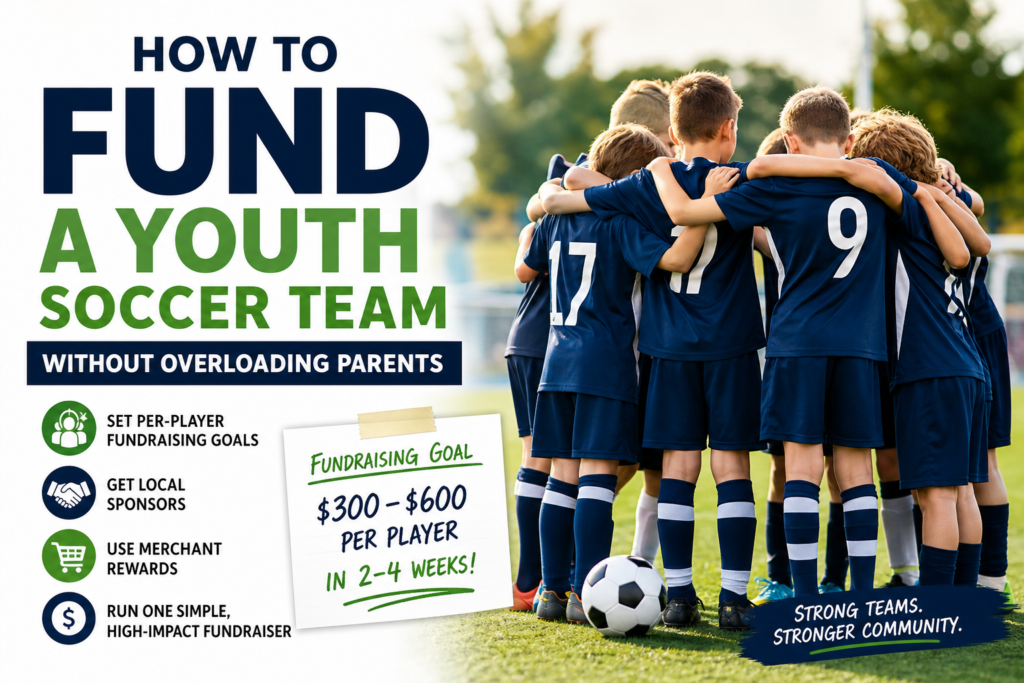
You can fund a youth soccer team without overloading parents by setting a clear per-player goal, using sponsorships and merchant rewards instead of constant fee increases, and running one short, high-participation fundraiser rather than several small ones.
A realistic target is $300 to $600 per player within two to four weeks, using a simple plan and a focused timeline.
What Does It Really Cost to Run a Youth Soccer Team?
Unexpected costs are one of the biggest reasons families feel overwhelmed during the season. Sharing the full budget early helps reduce stress and builds trust.
Typical seasonal budgets include recreation teams ranging from $3,000 to $7,000, competitive club teams from $12,000 to $30,000, and school programs from $5,000 to $20,000 depending on travel and equipment.
Common expenses include league fees and referees, uniform kits, tournament entry fees, training equipment, travel support, and scholarships.
A practical rule is this: if you want to avoid increasing parent fees, plan to raise $6,000 to $12,000 for a team of 14 to 18 players.
What Is a Fair Fundraising Goal Per Player?
Setting a per-player goal keeps fundraising fair and easy to manage. It also prevents a small number of families from carrying the entire financial burden.
Use these targets as a baseline: $250 per player for recreation teams, $400 per player for most teams, and $600 per player for travel-heavy seasons.
For example, 16 players raising $400 each equals $6,400. Adding four sponsors at $500 each brings in another $2,000, resulting in a total of $8,400. This amount can cover uniforms, tournaments, and equipment without raising dues.
How to Fund a Team Without Constant Selling
Running multiple small fundraisers often leads to burnout. A better approach is to use a simple three-part plan.
Start with one short, high-participation fundraiser to cover the core budget. Add local sponsorships to bring in predictable funding. Then include merchant rewards programs to generate passive income throughout the season.
This combination reduces pressure on parents while keeping fundraising efficient and manageable.
Which Fundraisers Require the Least Parent Effort?
If your goal is to reduce stress, choose fundraisers that are simple and easy to manage.
Sponsor drives offer high returns with minimal effort. Merchant rewards programs provide passive income without extra work. Digital pledge campaigns are effective and quick to run. Community-based options like camps or concession partnerships can also generate steady income.
Avoid fundraisers that involve product handling, deliveries, or multiple small events, as they often reduce participation.
How to Run a One-Week Sponsor Drive
Sponsorship Packages
Keep your offers simple with three clear options.
Bronze sponsorship at $250 includes a thank-you mention. Silver sponsorship at $500 adds logo placement. Gold sponsorship at $1,000 includes premium recognition.
A realistic outcome might include several sponsors across these tiers, generating around $5,000 or more within a short period.
Simple Timeline
Begin by creating a list of potential sponsors. Reach out to families for leads and contacts. Send emails and follow up consistently over several days. Collect payments, confirm details, and publicly thank sponsors.
A focused ten-day plan keeps everything organized and efficient.
Copy-Paste Sponsorship Message
Hi [Business Owner Name],
My name is [Your Name], and I help lead the [Team Name] youth soccer team in [City]. We are raising funds to cover season costs such as league fees, tournaments, uniforms, and equipment.
We are inviting a small group of local businesses to sponsor our team. Your support helps reduce costs for families and keeps soccer accessible in our community.
We offer sponsorship options at $250, $500, and $1,000, each with different levels of recognition.
Thank you for supporting local athletes.
Best regards,
[Your Name]
How to Raise $300 to $600 Per Player
A focused two to four week campaign works best.
The first week should focus on planning and setting goals. The second week should be the main fundraising push. The third week should be used for follow-ups and closing contributions. The final week can be used for wrapping up and thanking supporters.
What Should Each Player Do?
A realistic expectation is for each player to reach out to at least 25 contacts. For higher goals, aiming for 40 contacts can increase results significantly.
Consistent follow-ups often make the biggest difference in achieving fundraising targets.
How to Keep Fundraising Fair
Fairness comes from equal effort expectations rather than equal financial outcomes.
You can use an effort-based model where all players complete the same tasks. Another option is an opt-out fee for families who prefer not to participate. A blended approach can combine both strategies.
Clear rules set at the beginning help avoid confusion and frustration later.
How to Communicate With Parents
Clear communication reduces pressure and improves participation.
Explain the total budget, the fundraising goal, and the timeline upfront. Offer options so families feel comfortable choosing how they want to contribute.
Keeping everything transparent builds trust and cooperation.
Using Merchant Rewards for Passive Income
Merchant rewards programs allow families to contribute simply by making everyday purchases.
These programs typically generate a modest amount per family but can add up significantly across a full team or multiple seasons.
They work best as a long-term funding strategy rather than a primary source of income.
Real-World Funding Examples
A recreation team might raise $6,500 through a mix of player contributions, sponsorships, and rewards programs.
A travel team could reach $12,000 by combining higher per-player goals with sponsor support.
A school program may achieve $20,000 through coordinated efforts across multiple teams and funding sources.
Step-by-Step Plan
Start by creating a clear budget. Set a per-player fundraising goal. Choose one main fundraiser. Run a sponsor drive alongside it. Track progress carefully. Finish the campaign early so the team can focus on the season.
Frequently Asked Questions
How much should parents pay if fundraising is successful?
Many teams can avoid increasing fees by raising $300 to $600 per player along with sponsorship support.
How long should fundraising last?
A two to three week campaign is usually the most effective.
What requires the least effort?
Sponsor drives combined with passive income strategies typically require the least ongoing work.
What about families who cannot participate?
Offer flexible options such as opt-out fees or confidential support to keep participation fair.
How many sponsors are needed?
Even a small number of sponsors can significantly reduce the financial burden on families.
Final Thoughts
The most effective fundraising strategy is not about doing more. It is about doing the right things in a focused and organized way. A short, well-planned campaign can fully support your team without overwhelming parents.