

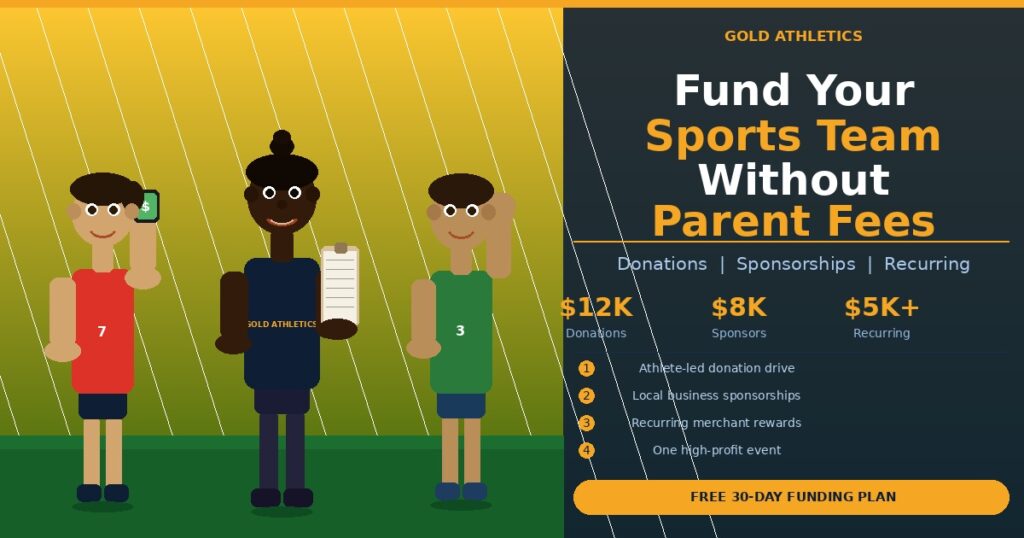
Quick Answer: The fastest way to fund a sports team without raising parent fees is to combine four revenue streams: an athlete-led donation drive, local business sponsorships, a recurring revenue program, and one high-profit community event. Because most teams fail from inconsistent athlete participation rather than lack of community support, fixing accountability fixes the fundraising.
What Is the Fastest Way to Fund a Sports Team Without Charging Parents More?
The fastest option is an athlete-led donation drive because it creates cash flow in days, not months.
If you need $8,000 for uniforms or $15,000 for travel and officials, donation-based fundraising wins on both speed and margin. There is no inventory, no delivery, and no profit split eating into your total.
Gold Athletics uses exactly this approach through its on-site Blitz Day format, where athletes make donation asks together in a focused event and coaches track participation through an app in real time. Because most teams fail from inconsistent athlete participation rather than lack of supporters, that structure is what separates programs that hit their goals from those that fall short.
How Do You Replace the Money You Normally Get From Parents?
You replace parent fees by stacking four funding buckets that do not rely on new charges.
Most teams can build a stable plan by mixing:
- Individual donations from extended family and community supporters
- Local business sponsorships with clear visibility packages
- A recurring revenue stream such as merchant rewards or monthly giving
- One or two signature community events that become seasonal traditions
Realistic example for a program needing $25,000:
| Source | Amount |
|---|---|
| Athlete-led donation drive | $12,000 |
| Local business sponsorships | $8,000 |
| Merchant rewards or monthly giving | $3,000 |
| One community event | $2,000 |
None of that requires asking parents to pay more. Parents can still participate, but they are no longer the primary funding source.
Why Do Most Fundraisers Underperform When You Try to Avoid Parent Fees?
They underperform because athlete participation drops without accountability.
The biggest predictor of fundraising results is not the idea. It is whether every athlete actually does the work. Common failure points include:
- Athletes told to fundraise at home with no structure or script
- Coaches without time to follow up one by one
- The same five families carrying the entire load again
- No visibility into who has actually reached out to supporters
Because an app-driven accountability system makes outreach activity visible to coaches and the team, effort goes up and results follow. When participation is tracked publicly, ordinary fundraisers produce strong results. When participation is ignored, even a great format fizzles.
How Do You Run a Donation Drive That Does Not Feel Awkward?
You run it like a team activity with a script, a deadline, and volume targets.
A donation ask only feels awkward when athletes ramble or apologize. Supporters respond well to clarity and confidence, especially when the ask is tied to a real and specific need.
What Should Athletes Say When They Ask for a Donation?
Use a simple, direct script:
“Hi, our team is raising $12,000 for new helmets and reconditioning. Can you support me with a donation of $50 or $100 today? Here is the link. Thank you for backing our program.”
That message is short, respectful, and easy to answer yes or no.
What Donation Amounts Should You Suggest?
Offer two to three specific options that match your community’s giving capacity:
- $25 for general supporters
- $50 for extended family and neighbors
- $100 for alumni and community members
If your community has stronger capacity, add $250 for business owners and alumni. Specific numbers reduce hesitation. Vague asks create delay.
How Do You Structure a One-Day Donation Push?
Treat it like practice, not like homework.
- Preload contact lists the day before with at least 30 contacts per athlete
- Run a two-minute kickoff explaining the goal and the why
- Give athletes a short script and a target such as 20 messages in 20 minutes
- Track outreach in real time and keep effort visible to the full team
- Close with a follow-up push for anyone who did not reply within 24 hours
Gold Athletics uses this structure in its Blitz Day model, designed specifically to reduce coach workload while driving full-roster participation. The key is focused time, live coaching, and real accountability together.
How Do You Get More Athletes to Participate Without Constantly Nagging Them?
You make participation public, simple, and time-limited.
Athletes respond to three things: clarity, competition, and deadlines. When the process is vague and open-ended, they put it off indefinitely.
Participation levers that work:
- A team goal board that updates in real time during the push
- A participation metric based on messages sent rather than dollars raised
- Small prizes funded by donations such as a team meal or gear item
- A short campaign window such as one focused day plus seven days of follow-ups
When outreach is tracked in an app that coaches can see, participation increases without the need for constant reminders. It saves coaches from chasing screenshots and guessing who is actually working.
How Do You Raise Money From Local Businesses Without Feeling Pushy?
You sell community exposure, not just a logo on a banner.
Local businesses sponsor teams when they see a clear and consistent return. You do not need to promise large audiences. You need to offer real visibility and a clean, professional process.
What Should You Charge for Sponsorships?
Price based on what you can deliver consistently:
| Tier | Price | Benefits |
|---|---|---|
| Bronze | $250 | Social media shoutout plus website listing |
| Silver | $500 | Banner at home games plus two shoutouts |
| Gold | $1,000 | Banner, announcer reads, and program ad |
| Title Sponsor | $2,500 | Named game or event plus top placement |
If you secure 10 businesses at $500 and 3 at $1,000, that is $8,000 with zero parent fee increases.
How Do You Ask Businesses the Right Way?
Ask in person when possible, with a one-page sponsorship sheet and a clear deadline.
The ask has three parts:
- Here is our program and what we are funding this season
- Here are three sponsorship options with specific benefits
- Can we count on you for $500 by Friday so we can print banners
Most business owners decide quickly when the offer is clear and the deadline is real.
How Do You Create Recurring Revenue That Keeps Funding the Team Year After Year?
You build a program that families and local supporters actively use every month.
Recurring revenue protects your program when a season fundraiser falls short or a key volunteer steps down. Additionally, it removes the pressure of relying entirely on one annual campaign.
Recurring options that work consistently:
- A merchant rewards network offering discounts and perks at local businesses
- A monthly giving club for alumni and community supporters at $10 to $25 per month
- Facility signboard renewals that auto-renew on a set date each year
Gold Athletics includes a merchant rewards network as part of its fundraising program, which creates ongoing value for families and a reason for local businesses to stay connected beyond the campaign window. Even $10 per month from 40 supporters generates $4,800 per year toward tournament fees, equipment, and travel costs.
What Events Raise the Most Money Without Draining Families?
One high-profit event beats a calendar full of small, repetitive asks.
If your families are already tired, stop stacking fundraisers and choose one event that can become an annual tradition.
Events that often net $2,000 to $10,000 depending on community size:
- Golf scramble with sponsorships and foursomes
- Cornhole tournament with food trucks and a raffle
- Youth skills camp run by players and coaches
- Community dinner with a silent auction
- Alumni game with ticket sales and sponsor packages
The key to event profit is sponsorships, not ticket sales.
A dinner for 250 people at $20 per ticket grosses $5,000. If food costs $3,500, you net only $1,500. Add $5,000 in sponsorships and donated auction items and you clear $6,500 without raising ticket prices.
How Do You Get Free or Discounted Gear Instead of Raising Cash?
You ask for in-kind donations that replace budget line items directly.
Not every need requires cash. Many athletic budgets leak through things you can replace with donated goods and services.
Start with a specific in-kind request list:
- Pre-game meals for home game dates
- Bus sponsorships for away trips
- Team photographer for the season
- Athletic trainer coverage for events
- Printing for banners and programs
- Water, ice, and sports drinks
Then assign dollar values and find sponsors for each line item. If a bus trip costs $750, ask a local bank to sponsor two trips for $1,500 with logo placement on your travel posts and schedule graphics. That is a fair trade, not a favor.
How Do You Find Grants for School Sports That Most Programs Miss?
You start local, then work outward to state and national sources.
Many teams skip grants because they sound complicated. In reality, small local grants are often simpler to apply for than major national ones.
Start with these sources:
- Local community foundations
- Rotary, Kiwanis, and Lions clubs
- Hospital community benefit programs
- Youth health and wellness nonprofits
- City and county recreation support funds
Your one-page needs statement should include:
- Who you serve and how many athletes participate
- What you need to purchase and the exact dollar amount
- The date funds are needed
- How you will report outcomes to the grantor
A specific ask for $3,000 toward safety gear with a clear outcome plan consistently outperforms a general request for program support.
What Budget Changes Reduce the Need for Fundraising Immediately?
You audit spending like an athletic director before you run another campaign.
Cutting $4,000 from expenses produces the same result as raising $4,000. It also reduces stress on families, coaches, and volunteers.
High-impact areas to review:
- Uniform cycles: extend from three-year to five-year rotation where possible
- Apparel orders: separate required team gear from optional purchases
- Travel: combine JV and varsity buses when schedules allow
- Equipment: buy quality used items for non-safety equipment such as cages, nets, and sleds
- Tournament selection: reduce overnight trips and increase local event participation
What Is a Simple 30-Day Plan to Fund a Team Without Charging Parents More?
Follow this four-week sequence with clear ownership at every step:
Week 1: Set your budget target and decide your funding mix. Build a sponsor sheet and assign 10 business visits to specific volunteers.
Week 2: Run your athlete-led donation day with live coaching and collect fast wins. Post daily updates to keep momentum high.
Week 3: Follow up on every non-response from the donation drive and close open sponsorships before the deadline.
Week 4: Lock one recurring revenue stream and confirm the date for your one signature community event.
If you want to reduce coach workload throughout this process, use a system that provides live coaching, a one-day push format, and athlete accountability tracking. That is why many school programs partner with Gold Athletics to execute this model season after season.
Frequently Asked Questions
What fundraiser makes the most profit with the least effort? Donation drives produce the highest net profit for most teams because there is no product cost, no delivery logistics, and results arrive quickly when athletes follow through on outreach. Additionally, combining a donation drive with business sponsorships gives you the strongest return per hour of effort.
How much can a team realistically raise without asking parents to pay more? Many teams raise $10,000 to $30,000 by combining donations, sponsorships, and one community event, depending on roster size and community support. Because participation rate matters more than community wealth, a focused accountability system often matters more than location.
How do you prevent the same families from carrying every fundraiser? Track athlete participation publicly, set minimum outreach expectations for every player, and make effort visible so no single family can carry the load alone. When accountability is built into the system rather than left to the coach, participation spreads naturally across the full roster.
Are business sponsorships worth it for smaller towns? Yes. Because local businesses in smaller communities often have stronger ties to schools and sports programs, they frequently respond better to a direct ask with clear benefits than businesses in larger markets. Keep pricing simple with tiers at $250, $500, and $1,000 and deliver exactly what you promise.
What is the best way to run fundraising without adding work for the coach? Use a structured one-day push with live coaching and an accountability tool that tracks outreach activity automatically. Because Gold Athletics is built specifically to reduce coach workload through its Blitz Day model and app-driven tracking, many programs report fewer hours spent on fundraising while raising more than previous seasons.
Can a merchant rewards program actually fund athletics long term? Yes. A merchant rewards network creates recurring revenue and keeps local businesses engaged through ongoing discounts and perks. When participation is tracked and renewals are scheduled annually, even modest monthly contributions from 30 to 50 supporters can generate $3,000 to $6,000 per year toward operating costs.