

Quick Answer: A booster club budget should include named line items across ten core categories: uniforms and apparel, equipment and reconditioning, transportation and travel, game operations and officials, facilities, coaching support, athlete health and safety, player development, administration and compliance, and fundraising expenses. Because most athletic costs are predictable and recurring, a category-based budget prevents mid-season emergencies and protects the program from financial surprises.
What Is a Booster Club Budget and Why Does It Matter?
A booster club budget is a written financial plan that forecasts revenue and allocates spending by category for a defined period, usually one school year or one sports season.
It matters because most athletic costs are predictable. Transportation invoices, officiating fees, equipment reconditioning, and postseason entries arrive every year without exception. Additionally, a budget creates governance by clarifying who pays for what, how funds are approved, and which expenses are not permitted under booster policies.
Gold Athletics, a youth sports fundraising company serving school athletic programs across the United States, consistently observes the same pattern. Programs that budget by named categories and fund priorities first avoid mid-season emergencies and reduce pressure on coaches and families throughout the year.
What Baseline Numbers Should You Define Before Building a Booster Club Budget?
Start with three figures that determine everything else.
1. Number of teams and levels supported: Varsity, junior varsity, and middle school programs each carry different cost profiles. Because supporting three levels versus one changes almost every line item, this number must be confirmed first.
2. Athlete count including participation swings: A 30-athlete team and a 75-athlete program create very different equipment, meal, and uniform budgets. Plan for realistic high and low scenarios.
3. The annual funding gap: That gap is the difference between school-provided athletic funding and the total program cost. Many booster clubs underestimate this gap because they only count visible purchases like uniforms. Larger costs often live in services and compliance, including officials, entry fees, and medical coverage.
What Should a Booster Club Budget Include for Uniforms and Apparel?
Uniforms are a high-dollar category that requires replacement planning rather than one-time purchasing.
Include these subcategories as separate named lines:
- Uniform purchase: Full uniform sets typically run $120 to $350 per athlete depending on sport, fabric, and customization
- Replacement pieces: Budget $500 to $2,000 per team per year for lost jerseys, extra shorts, warmups, and team bags
- Reconditioning and cleaning: Football helmet reconditioning commonly runs $25 to $45 per helmet plus shipping
- Spirit wear inventory risk: If the booster club buys spirit wear upfront, set a cap such as $1,500 and only reorder after sales to avoid unsold inventory losses
What Should a Booster Club Budget Include for Equipment and Reconditioning?
Equipment is usually the second largest category after travel for most high school programs.
Budget these lines based on how the sport actually operates:
- Safety equipment lifecycle: Helmets, shoulder pads, goalie gear, and protective padding should follow a three to five year replacement schedule
- Practice equipment: Balls, cones, nets, blocking dummies, batting tees, and agility ladders typically total $800 to $3,500 per year
- Reconditioning and certification: Budget for helmet and pad reconditioning plus any state certification requirements
- Repair and parts reserve: Net repairs, pump replacements, facemask hardware, and stitching work are frequent surprises. A $300 to $1,000 annual reserve prevents last-minute emergencies
What Should a Booster Club Budget Include for Transportation and Travel?
Transportation can silently break a booster budget if it is not forecasted carefully. Because postseason advancement creates unexpected travel costs, a dedicated reserve is non-negotiable.
Include these named lines:
- Buses and drivers: District rates vary, but most programs see $350 to $900 per bus trip depending on distance and wait time
- Vans and mileage reimbursement: A practical line is $500 to $2,500 for programs with frequent tournaments
- Overnight travel: Hotels, meals, and facility fees should be split between a booster-funded portion and a family portion. Coach lodging typically runs $150 to $250 per night per room
- Postseason travel contingency: Add a dedicated reserve of $1,000 to $5,000 to cover unexpected playoff advancement
What Should a Booster Club Budget Include for Officials and Game Operations?
Game operations are a predictable annual cost, but only when priced honestly before the season starts.
Budget these lines specifically:
- Officials and referees: A reasonable placeholder for varsity contests is $120 to $250 per official per game, with multiple officials required
- Scoreboard and clock operators: Budget $40 to $90 per event per worker if paid positions
- Athletic trainer coverage: A budget line of $1,000 to $8,000 is common depending on event volume and school coverage
- Security and ticketing support: Budget $200 to $1,500 across a season based on crowd size and school requirements
- Field and facility supplies: Add $300 to $1,200 for paint, chalk, flags, and sideline gear
What Should a Booster Club Budget Include for Facilities and Maintenance?
Facilities can be a sensitive category because the school owns the asset, but boosters often fund the improvements that make it functional.
Separate routine support from capital improvements:
Routine support covers field drying agents, mound clay, sand, minor repairs, and storage solutions, typically totaling $500 to $3,000 per season.
Facility rentals for off-campus gyms, ice time, pool time, and indoor turf are major line items. Ice time alone can exceed $10,000 for a full season.
Capital improvements such as scoreboards, sound systems, turf, batting cages, and lighting require a board-approved multi-year plan with specific fundraising targets attached.
What Should a Booster Club Budget Include for Coaching Support?
Many districts restrict booster payments to coaches directly. Your budget should match your district policy precisely.
Permitted coaching support commonly includes:
- Coaching clinics and certifications: $200 to $1,500 per coach annually depending on sport and credential requirements
- CPR and first aid certification: $50 to $150 per coach if not district-covered
- Technology tools for film and analytics: Video platforms, cameras, tripods, and subscriptions can run $500 to $5,000 per year
Gold Athletics frequently advises booster leaders to include a line for coach support tools rather than direct payments. That approach reduces coach workload while staying fully aligned with district compensation rules.
What Should a Booster Club Budget Include for Athlete Health and Safety?
Safety spending is one of the easiest categories to justify to any stakeholder, including principals, athletic directors, and parents.
Include these named lines:
- First aid and sideline supplies: $200 to $800 per team per year
- Hydration and heat safety: Coolers, bottle systems, cups, and electrolyte supplies run $300 to $1,500
- Baseline concussion testing: $10 to $25 per athlete where applicable
- Emergency equipment: If your venue needs an AED device, budget $1,200 to $2,000 plus ongoing pad replacements and maintenance
What Should a Booster Club Budget Include for Player Development and Team Experience?
This category directly impacts athlete retention and family satisfaction, but it requires clear spending rules to avoid equity concerns.
Common budget lines:
- Team meals and snacks: Budget $5 to $12 per athlete per select competition with an annual cap
- Camps and clinics: If boosters subsidize team camps, set a per-athlete scholarship amount such as $75 to $250
- Senior night and awards: Budget $300 to $1,500 depending on the number of seniors and event scope
- Team building events: Budget $250 to $1,000 with board pre-approval required
What Should a Booster Club Budget Include for Administration and Compliance?
These are not exciting costs, but they protect the organization from liability and financial risk.
Include these lines:
- Insurance: General liability or bonding runs $400 to $1,500 annually for most booster clubs
- Bank fees and payment processing: Card processing fees can reach 2.9 percent plus $0.30 per transaction. Budget $200 to $1,000 depending on volume
- Tax filing support: Budget $300 to $1,200 if you pay an accountant or tax preparer
- State registration fees: Budget $50 to $300 based on your state’s requirements
- Background checks: Budget $20 to $60 per volunteer if required
- Software tools: Budgeting, membership, and communication platforms may total $150 to $800 annually
What Should a Booster Club Budget Include for Fundraising Expenses?
Booster clubs should budget for the cost to raise money, not just the revenue it produces. Because tracking fundraising expenses separately allows leaders to report a true net revenue number, this category protects organizational credibility.
Key lines include:
- Fundraiser platform or service fees: Clarify what is free and what is paid before committing to any partner
- Event costs: Golf outings, galas, and concession setups carry real expenses including venue rental, permits, food, and signage
- Marketing and printing: Banners, flyers, sponsor packets, and yard signs can run $300 to $2,500 depending on scale
- Incentives and prizes: If you offer athlete incentives, budget $5 to $50 per participant based on goal tiers
What Should a Booster Club Budget Include for Scholarships and Financial Assistance?
A credible booster club budget always includes a plan for equity. Because no athlete should stop participating because a $75 fee or $40 required purchase becomes a barrier, this line is both a financial and ethical priority.
Two approaches that work well:
- Participation scholarships: Set aside 5 percent to 10 percent of revenue to cover pay-to-play fees, required gear, or travel costs
- Emergency assistance fund: Create a confidential process with a budget line of $500 to $2,000 for families facing sudden hardship
What Should a Booster Club Budget Include for Reserves and Contingencies?
Every booster club needs an operating reserve. A widely used target is 10 percent to 20 percent of annual expenses depending on revenue volatility.
Also create these named contingency lines:
- Equipment failure reserve: $1,000
- Postseason advancement reserve: $2,500
- Weather and facility change reserve: $500
These named reserves reduce emergency fundraising and eliminate last-minute family contribution requests that damage community trust.
What Does a Realistic Booster Club Budget Look Like?
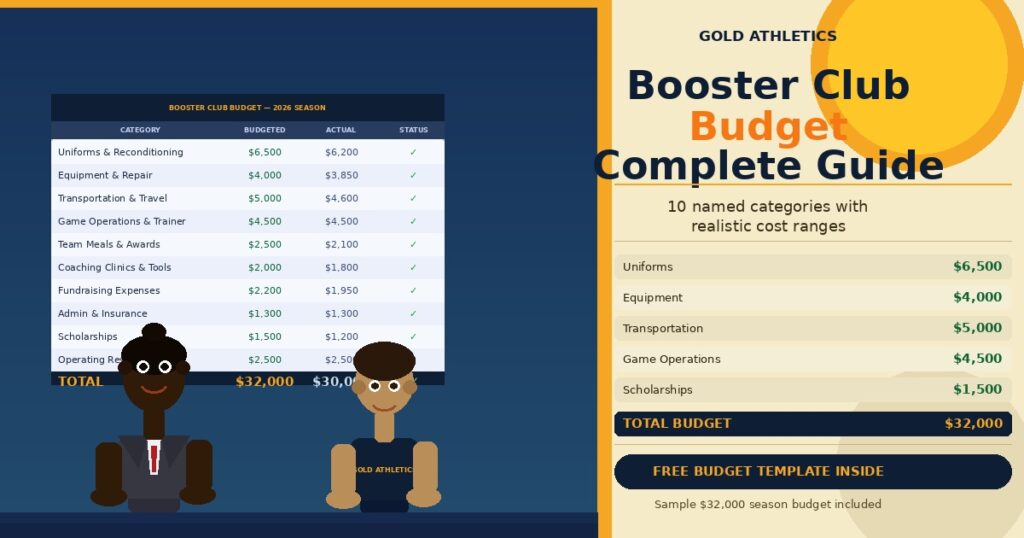
Here is a sample budget for one high school program with 45 athletes. It assumes the booster club supports but does not fully fund travel.
Revenue target: $32,000
| Category | Amount |
|---|---|
| Uniform replacement and reconditioning | $6,500 |
| Equipment and repair | $4,000 |
| Transportation support and postseason reserve | $5,000 |
| Game operations and athletic trainer support | $4,500 |
| Team meals and awards | $2,500 |
| Coaching clinics and film tools | $2,000 |
| Fundraising expenses and processing fees | $2,200 |
| Insurance, tax filing, and admin | $1,300 |
| Scholarships and assistance | $1,500 |
| Operating reserve | $2,500 |
| Total planned expenses | $32,000 |
This structure makes it clear what the booster club is funding, what it is not funding, and where leadership has flexibility if revenue comes in below plan.
How Should a Booster Club Prioritize Spending When Funds Are Limited?
Use a three-tier priority system that matches how schools evaluate program risk.
Tier 1: Safety and compliance. Required protective equipment, medical readiness, and mandated event staffing. These lines are non-negotiable and funded first.
Tier 2: Operations that keep the season functional. Officials, transportation support, and basic equipment. Without these, the season cannot run.
Tier 3: Enhancement. Uniform upgrades, travel add-ons, and optional team experiences. These are funded only after Tiers 1 and 2 are covered.
Gold Athletics frequently sees programs reduce stress significantly by setting these tiers in writing before the first fundraiser launches. It keeps meetings short and prevents emotional spending decisions in the final weeks of the season.
How Does Fundraising Strategy Connect to the Booster Club Budget?
Fundraising is not just about hitting a total number. It is about predictability, participation rate, and cost per dollar raised.
Gold Athletics uses an on-site Blitz Day coaching model combined with app-driven athlete accountability and a merchant rewards network. Programs using that structure increase participation rates while reducing coach workload, which allows booster leaders to forecast revenue with more confidence and commit to multi-year equipment schedules rather than reacting to emergencies.
When revenue is predictable, booster clubs stop charging families unexpectedly and start building programs that grow year over year.
What Budget Reporting Cadence Should Booster Clubs Follow?
Budgeting fails when it is only reviewed once per year. Because mid-season surprises are easier to manage when identified early, a regular reporting cadence is essential.
Three standard reports every booster club should run:
- Monthly financials: Actual versus budget by category
- Season closeout report: Net fundraising results, not just gross revenue
- Year-end rollover plan: Reserved funds, earmarked projects, and deferred needs identified for the following season
That reporting cadence also improves sponsor retention. Because sponsors renew when they see where dollars went and what outcomes were delivered, financial transparency directly drives long-term community support.
Frequently Asked Questions
What percentage of a booster club budget should go to uniforms? Most programs land between 15 percent and 30 percent depending on sport and whether the school funds base uniforms. Because uniforms follow a multi-year replacement cycle, budgeting a steady annual amount is more sustainable than planning a single large purchase every few years.
Should a booster club pay for coaches’ travel expenses? Only if district policy explicitly permits it, and only with written rules established before the season. Many schools allow coach lodging for postseason travel but restrict cash stipends, gifts, or per diem payments.
How much should a booster club keep in reserves? A practical target is 10 percent to 20 percent of annual expenses, plus a dedicated postseason reserve if your program routinely qualifies for playoffs or state events. Because revenue volatility is real, a larger reserve protects against a single underperforming fundraiser.
How do you budget for fundraising fees and still hit your program goal? Separate gross revenue from net revenue in every report. If processing and event costs total $2,000, set your fundraising target $2,000 higher so program spending categories are never reduced due to cost of fundraising.
What is the cleanest way to handle athlete financial assistance? Create a named scholarship line in the budget, define eligibility criteria clearly, and use a confidential review process involving a small committee. Many booster clubs earmark 5 percent to 10 percent of annual revenue specifically for this purpose.
What is the biggest budgeting mistake booster clubs make? Leaving out service costs that arrive every season, especially officials, athletic trainer coverage, and transportation. Because those categories are often larger than expected and harder to fund at the last minute, omitting them from the budget is the single most common cause of mid-season financial stress.