

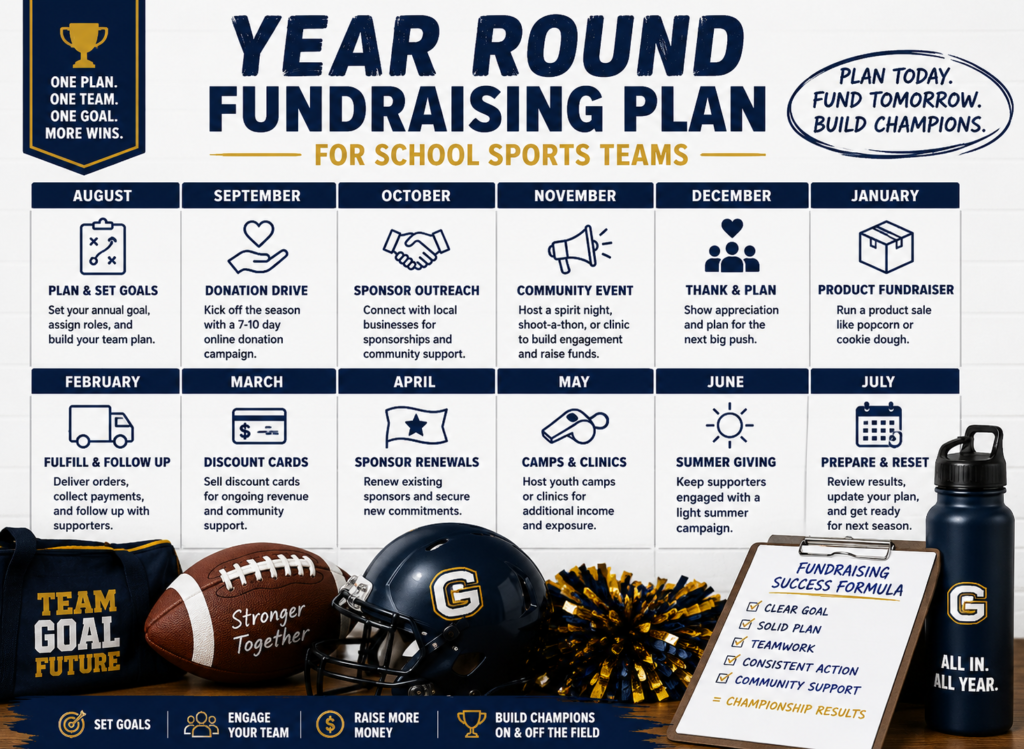
Quick Answer: A year round fundraising plan for a school sports team is a structured 12 month strategy that combines donation campaigns, sponsorships, product fundraisers, and recurring revenue streams to create predictable income without overwhelming parents or athletes. The most successful programs typically run one major fundraiser per season while maintaining one ongoing revenue source such as sponsorship banners or discount cards.
Why Does Every School Sports Team Need a Year Round Fundraising Plan?
Most teams fail financially because they treat fundraising like an emergency instead of a system.
When coaches wait until uniforms need replacing or travel bills arrive, families feel pressure immediately. However, programs that spread fundraising across the year usually raise more money with less stress.
A structured fundraising calendar helps teams:
- Reduce parent burnout
- Increase athlete participation
- Improve sponsor retention
- Avoid last minute financial gaps
- Build predictable yearly revenue
- Keep booster clubs organized
This is why many modern athletic programs now use year round fundraising models instead of relying on one large seasonal push.
What Should a Year Round Fundraising Plan Include?
A strong year round fundraising plan for a school sports team should include four core elements:
1. One Clear Annual Fundraising Goal
Parents support programs faster when they understand exactly where the money goes.
Instead of saying:
“We need to raise money.”
Say:
“We are raising $21,000 for uniforms, travel, player scholarships, and training equipment.”
Specific goals convert better.
2. A 12 Month Fundraising Calendar
Most successful teams schedule fundraising before the season becomes hectic.
A balanced calendar usually includes:
- Fall donation campaign
- Winter product fundraiser
- Spring sponsorship push
- Summer youth clinic
- Ongoing merchant rewards or discount cards
3. One Ongoing Revenue Stream
The best programs create recurring income instead of restarting from zero every season.
Examples include:
- Sponsorship banners
- Discount card fundraisers
- Merchant rewards programs
- Booster memberships
- Monthly donor clubs
4. Athlete Accountability
Participation increases when athletes know exactly what is expected.
Programs using leaderboards, app tracking, and daily goals consistently outperform teams that rely only on parent reminders.
How Do You Set the Right Fundraising Goal?
Start by pricing out the full season.
Most teams underestimate expenses because they only budget for obvious costs like uniforms.
Instead, include:
- Equipment
- Travel
- Meals
- Tournament fees
- Team apparel
- Training tools
- Scholarships
- Facility upgrades
- Technology subscriptions
Example Fundraising Goal Breakdown
Here is a realistic example for a basketball program:
| Expense | Cost |
|---|---|
| Warmups | $4,000 |
| Practice gear | $2,500 |
| Travel and tournaments | $6,000 |
| Tournament fees | $1,500 |
| Shooting machine contribution | $3,000 |
| Scholarships | $2,000 |
Total expenses: $19,000
Add a 10 percent buffer:
$19,000 × 1.10 = $20,900
Rounded goal:
$21,000
Once the number becomes specific, fundraising becomes easier to organize and communicate.
How Do You Build a 12 Month Team Fundraising Calendar?
The biggest mistake teams make is stacking every fundraiser into the same season.
Instead, spread campaigns throughout the year.
Here is a practical structure many school programs follow successfully.
August: Goal Setting and Planning
August determines whether fundraising feels organized or chaotic.
During this month:
- Set your annual fundraising target
- Confirm fundraiser dates
- Assign responsibilities
- Build parent communication templates
- Create athlete participation expectations
Quick takeaway:
If fundraising dates are not scheduled early, the season becomes reactive instead of strategic.
September: Digital Donation Campaign
This is often the fastest way to generate revenue with minimal overhead.
Example Revenue Math
40 athletes
Each athlete sends 15 donation asks
40 × 15 = 600 asks
If 20 percent donate:
600 × 0.20 = 120 donors
Average donation:
$65
120 × $65 = $7,800
Add one local business sponsor:
$500
Projected total:
$8,300
This is why short digital campaigns with strong follow up systems work so well.
October: Sponsorship Outreach
October is ideal for local business outreach because many companies are planning future marketing budgets.
Example Sponsorship Structure
| Sponsor Type | Quantity | Value | Total |
|---|---|---|---|
| Small sponsors | 10 | $250 | $2,500 |
| Mid level sponsors | 5 | $500 | $2,500 |
| Premium sponsors | 2 | $1,500 | $3,000 |
Total projected sponsorship revenue:
$8,000
Simple Sponsor Benefits
Keep packages easy to understand:
- Field banners
- Social media recognition
- Website placement
- Game day shoutouts
- Program advertisements
Simple packages close faster.
November: Community Fundraiser or Spirit Event
This is a great visibility month.
Popular options include:
- Restaurant give back nights
- Shootathons
- Kickathons
- Youth skills clinics
- Parent versus player events
Example Shootathon Math
30 athletes
5 sponsors per athlete
Average pledge: $20
30 × 5 × $20 = $3,000
Events work best when participation feels fun instead of mandatory.
December: Donor Retention and Appreciation
December should focus on relationships rather than aggressive fundraising.
Use this month to:
- Thank sponsors publicly
- Share impact photos
- Post progress updates
- Send appreciation emails
- Prepare spring campaigns
Programs that show impact consistently improve donor retention rates.
January: Product Fundraiser Launch
Product fundraisers still work well when timelines stay tight.
Cookie dough and popcorn remain popular because families already understand them.
Cookie Dough Example
35 athletes
10 items sold each
$8 profit per item
35 × 10 × $8 = $2,800
Popcorn Example
40 athletes
$250 average sales each
40 percent profit margin
40 × $250 × 0.40 = $4,000
Important:
Do not run multiple product fundraisers back to back.
That usually lowers participation.
February: Fulfillment and Follow Up
February is operational.
This month should focus on:
- Deliveries
- Order tracking
- Volunteer scheduling
- Customer communication
- Final payment collection
A smooth fulfillment process protects your booster club from unnecessary stress.
March: Discount Cards and Merchant Rewards
This is where recurring revenue becomes powerful.
Example Discount Card Fundraiser
300 cards sold at $25
300 × $25 = $7,500 gross revenue
If profit per card is $15:
300 × $15 = $4,500 profit
Athlete Participation Example
40 athletes
10 cards each
40 × 10 = 400 cards
400 × $15 = $6,000 profit
Programs often use merchant rewards because they can repeat annually with predictable success.
April: Sponsor Renewals
Many programs wait too long to renew sponsors.
April works well because businesses are planning summer and fall budgets.
This month should include:
- Early renewal offers
- Multi sport sponsorship packages
- New advertising opportunities
- Updated sponsor materials
Example Renewal Revenue
12 sponsors × $300 = $3,600
Retention is usually easier than finding new sponsors from scratch.
May: Youth Camps and Clinics
Youth camps generate both revenue and long term program growth.
Example Camp Revenue
60 campers
$50 registration fee
60 × $50 = $3,000
Estimated expenses:
$500
Projected profit:
$2,500
Additionally, youth camps strengthen your future athlete pipeline.
June: Light Summer Giving
Summer campaigns should stay simple.
Good June options include:
- Summer training donations
- Sponsor appreciation posts
- Alumni updates
- Offseason progress content
Avoid overwhelming families during vacation season.
July: Preparation and Reset
July is where strong programs prepare for smooth fall launches.
This month should focus on:
- Updating athlete contacts
- Preparing donation links
- Training athletes on scripts
- Finalizing campaign assets
- Confirming launch dates
Teams that prepare early usually fundraise faster.
How Do You Choose the Best Fundraisers for Your Team?
Every community responds differently.
The best fundraising plans usually balance:
| Fundraiser Type | Best For |
|---|---|
| Donation campaigns | Fast cash |
| Sponsorships | High dollar revenue |
| Discount cards | Recurring support |
| Product fundraisers | Broad participation |
| Community events | Visibility and culture |
The goal is balance, not constant fundraising.
How Do You Increase Athlete Participation?
Participation improves when athletes understand the process clearly.
Use these three rules:
Make Expectations Specific
Instead of:
“Help with fundraising.”
Say:
“Send 20 text messages tonight.”
Track Participation Publicly
Leaderboards create accountability naturally.
Coach the Process
Athletes perform better when coaches guide communication instead of leaving everything to parents.
What Is a Simple Athlete Accountability System?
A weekly checklist works extremely well.
Example Checklist
- Add 20 contacts
- Send donation messages
- Make 5 follow up calls
- Post one social media share
- Send thank you messages
Consistency matters more than intensity.
What Should Your Fundraising Communication Plan Look Like?
Most teams communicate too much.
Short scheduled updates perform better.
Recommended Communication Schedule
- Launch message
- Mid campaign reminder
- Final day urgency post
- Thank you update
Simple communication keeps families engaged without creating fatigue.
What Is a High Converting Donation Script?
Here is a simple athlete message template:
“Hi [Name], I’m raising money for [School] [Team] to help cover [specific need]. Would you consider supporting us with a donation of $25, $50, or $100? Here is my link: [link]. Thank you for supporting our program.”
Giving suggested donation amounts helps people decide faster.
How Much Money Can a Team Raise With a Year Round Fundraising Plan?
Teams usually raise significantly more when revenue is spread across multiple campaigns.
Example Annual Revenue Breakdown
| Fundraiser | Revenue |
|---|---|
| Fall donation campaign | $8,000 |
| Sponsorships | $8,000 |
| Winter product fundraiser | $4,000 |
| Discount cards | $6,000 |
| Spring clinic | $2,500 |
Projected annual total:
$28,500
Even if results fall 20 percent short, the program still raises approximately $22,800.
That can completely transform a school sports program.
Quick Action Steps You Can Start This Week
- Set one clear annual fundraising goal
- Schedule three fundraiser dates immediately
- Choose one recurring revenue stream
- Write athlete scripts before launch
- Create a parent FAQ document
- Build a sponsor list early
- Track participation publicly
Small preparation steps create massive long term improvements.
Conclusion: How Do You Build a Fundraising Plan That Actually Lasts?
A year round fundraising plan for a school sports team works best when fundraising becomes organized, predictable, and seasonal instead of emotional and reactive.
The strongest programs combine:
- Fast digital donation drives
- Sponsorship outreach
- One product fundraiser
- Recurring revenue streams
- Athlete accountability systems
When fundraising feels structured, participation improves naturally.
Programs using modern fundraising systems, athlete tracking tools, and structured campaign models often reduce stress while increasing annual revenue significantly.
Frequently Asked Questions
What is a year round fundraising plan for a school sports team?
A year round fundraising plan is a structured 12 month strategy that combines several fundraising campaigns throughout the year instead of relying on one large seasonal fundraiser.
How many fundraisers should a sports team run annually?
Most teams perform best with 3 to 5 fundraisers per year. Running too many campaigns often lowers participation and increases parent burnout.
What is the fastest fundraiser for school sports teams?
Digital donation campaigns are usually the fastest because they require minimal inventory, low overhead, and simple athlete participation.
Are sponsorships better than product fundraisers?
Sponsorships often generate larger individual contributions with fewer transactions. However, product fundraisers can increase broader community participation.
What is the best ongoing fundraising option?
Discount cards, merchant rewards programs, and sponsorship banners work well because they provide recurring annual revenue.
How do you improve athlete participation in fundraising?
Participation improves when goals stay specific, progress is tracked publicly, and coaches actively guide the process.
SEO Title: Year Round Fundraising Plan for School Sports Teams | Gold Athletics
Focus Keyphrase: year round fundraising plan for a school sports team
Slug: year-round-fundraising-plan-school-sports-team
Meta Description: Learn how to build a year round fundraising plan for a school sports team with donation campaigns, sponsorships, fundraising calendars, and real revenue examples.
Suggested Image Alt Text: year round fundraising plan for a school sports team calendar
Internal Link Suggestions:
- Sports team fundraising ideas
- Cookie dough fundraiser
- Booster club fundraising ideas
External Link Suggestion:
- NFHS fundraising or booster club resource page