

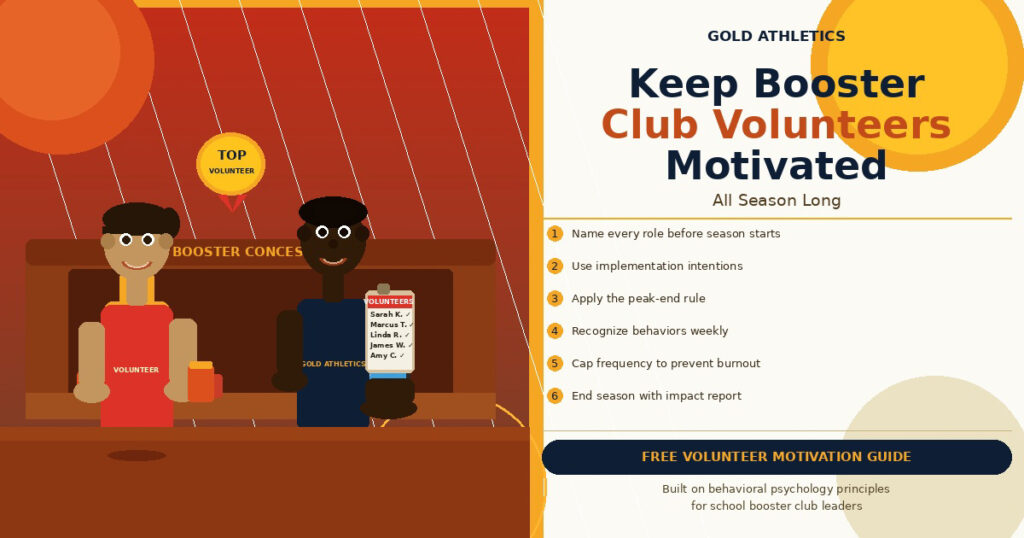
Quick Answer: Keeping booster club volunteers motivated throughout the season requires role clarity, consistent recognition, reduced friction, and visible impact. Because volunteer motivation is a leadership outcome rather than a personality trait, building a simple repeatable system around those four elements produces more reliable participation than any recruitment push or incentive program.
What Does Volunteer Motivation Actually Mean in a Booster Club?
Volunteer motivation is the sustained willingness to show up, do quality work, and return the following week. In a booster club context, it is not a personality trait. It is a leadership outcome shaped by role clarity, social norms, recognition, and friction in the system.
Research in behavioral psychology consistently shows that people persist longer when they feel autonomous, competent, and connected to others. This framework, known as self-determination theory, explains why booster club volunteers stay engaged when their roles are clear, their contributions are visible, and their effort is acknowledged specifically and promptly.
Why Do Booster Club Volunteers Lose Motivation Mid-Season?
Most volunteer drop-off is predictable. Because it comes from a short list of causes you can design around, understanding them is the first step toward preventing them.
The most common mid-season burnout triggers:
Role ambiguity is the leading cause. People quit when they are not sure what success looks like in their role.
Social loafing builds resentment fast. When roles are vague, the same few parents carry the entire load while others disengage quietly.
Decision fatigue accumulates in weekly operations. When every Friday requires a new plan from scratch, the cognitive cost becomes unsustainable.
Lack of feedback causes silent disengagement. Volunteers often do not know whether their work helped or was even noticed by anyone in leadership.
What Leadership System Keeps Booster Club Volunteer Motivation Stable?
Motivation stays stable when you run a simple system that creates certainty. Your job as a leader is to reduce friction, increase perceived impact, and create an environment where showing up is the norm rather than the exception.
Use a three-layer season structure:
- Layer 1: A season plan with all dates and role needs mapped out before the first event
- Layer 2: Weekly confirmation messages with clear start and end times for every shift
- Layer 3: Same-day check-in so nobody arrives confused about their assignment
This structure sounds basic, but it prevents the majority of volunteer failure points that booster clubs face every season.
How Do You Recruit Volunteers in a Way That Keeps Them Engaged?
Recruitment is where motivation begins. Because vague recruitment creates management problems throughout the season, the quality of your ask directly determines the quality of your volunteer culture.
A strong ask includes a defined finish line:
“We need two Concession Shift Leads for home football. You would work five games, arrive one hour before kickoff, and you can bring a friend. I will train you personally on the first game.”
That ask works because it reduces uncertainty and increases the volunteer’s sense of competence before they even start.
Named roles that map cleanly to booster club operations:
- Concession Shift Lead and Grill Captain
- Inventory and Restock Coordinator
- Ticketing Support Volunteer
- Spirit Wear Sales Lead
- Sponsor Banner Coordinator
- 50-50 Raffle Captain
- Team Meal Coordinator
- Fundraising Campaign Captain
- Volunteer Check-In Greeter
- End of Night Cash Count Team
- Team Photographer and Social Media Poster
When you name roles, you also make it easier to recruit by matching specific roles to individual personalities and schedules.
What Should Every Volunteer Receive Before Their First Shift?
Expectations reduce stress when framed as support rather than demands. Because perceived competence is one of the strongest drivers of continued participation, giving volunteers the information they need before they arrive directly improves retention.
Send a one-page role card by text or email that includes:
- Arrival time and exact location
- Dress code and any required items
- Exact tasks listed in order of priority
- Who to ask for help and how to reach them
- End time and checkout steps
- Where money goes and who handles it
This is not micromanagement. It is error prevention that protects both the volunteer and the program.
How Do You Use Behavioral Psychology to Improve Volunteer Follow-Through?
Effective booster clubs use practical behavioral design even when they do not use that language.
How Do You Make Showing Up the Default Behavior?
Use implementation intentions, a well-supported technique in behavioral research. Instead of asking “Can you help Friday?” ask: “Can I put you down for Friday from 5:30 to 8:30 at the main concession stand?”
Then send a confirmation message that repeats the specific time and place. Because specific cues reduce no-shows significantly, this one change consistently improves attendance rates.
How Do You Reduce Dropout After One Difficult Shift?
Apply the peak-end rule. Research shows people remember an experience by its most intense moment and its ending, not the average of the whole shift.
If a volunteer had a chaotic rush period, you can still protect their motivation by ending well. Have a designated Volunteer Check-In Greeter thank them by name at checkout, confirm the specific impact of their work, and tell them what is next. That final two minutes can determine whether they return for the next event.
How Do You Prevent Social Loafing and Resentment?
Make contribution visible. Post a simple volunteer scoreboard each week that lists names and roles completed. Keep it factual rather than competitive.
Because visibility increases accountability and communicates that participation is the norm, this one habit reduces the resentment that builds when the same few parents carry everything.
How Do You Divide Fundraising Work So It Feels Fair?
Many booster clubs overload the same people with both event operations and fundraising responsibilities simultaneously. Because that combination accelerates burnout faster than either role alone, separating them is essential.
A clean fundraising structure:
- Fundraising Campaign Captain: runs the calendar and all outreach messaging
- Team Level Parent Reps: manage reminders and questions from families
- Deposit and Tracking Lead: handles money collection and reporting
This prevents the common pattern where your most reliable concession lead is also chasing pledge sheets and following up on unpaid donations.
How Does Gold Athletics Reduce Booster Club Volunteer Burden?
Gold Athletics is specifically designed to reduce the manual work that drains volunteer motivation throughout the season.
Its on-site Blitz Day coaching model creates a defined fundraising moment with trained guidance rather than weeks of slow and inconsistent selling. The app-driven athlete accountability component keeps participation high without the booster club chasing every student individually. Additionally, the merchant rewards network adds an ongoing value stream that extends community engagement well beyond a single campaign event.
For many athletic departments, this structure lowers volunteer stress because the system carries part of the follow-up load that typically falls on a small overworked parent group.
What Recognition Actually Increases Volunteer Retention?
Recognition works when it is specific and timely. Generic praise is forgettable. Specific praise builds identity and loyalty.
Recognize behaviors, not just general effort:
- “You balanced the cash drawer perfectly and helped train two new parents tonight.”
- “You handled the inventory count, and we did not run out of water once during the game.”
- “You stayed calm during the halftime rush and kept the line moving the entire time.”
Do this weekly, not just at end-of-season banquets. Because recognition loses power when it is delayed, immediate specific feedback after each event produces the strongest retention effect.
Real recognition formats that fit booster club culture:
- A 30-second voice memo sent to a volunteer after the game
- Two volunteer names mentioned in the weekly athletics email from the athletic director
- A head coach thanking the Concession Shift Lead during a team huddle so athletes see the community support
How Do You Prevent the Same Few Parents From Doing Everything?
Over-functioning by a small group of parents is the hidden killer of volunteer culture. Because it teaches everyone else that the club will survive without them, it actively discourages new participation.
Use frequency caps to prevent overuse: No volunteer works more than two home events per month unless they opt in as a Lead. Then build a bench by pairing new volunteers with an experienced Lead for their first shift.
How do you handle the parent who always says yes? Give them a leadership title with narrower scope rather than letting them fill every gap. Instead of asking them to cover random needs, make them the Inventory and Restock Coordinator with clear authority and defined hours. Because high-capacity volunteers stay motivated when their effort produces a clean system rather than constant emergencies, this trade-off benefits everyone.
What Weekly Communication Keeps Volunteers Engaged Without Overloading Them?
Your weekly message should be short, predictable, and structured identically every time. Because consistency reduces cognitive load and increases response rates, using the same format weekly trains volunteers to act on it quickly.
Best weekly message format:
- One sentence impact update from the previous event
- Two key needs for the upcoming event
- A direct link to sign-ups
- One specific named thank-you
Report these metrics to show volunteers their time matters:
- Concession profit by game
- Average wait time improvement
- Number of volunteer shifts filled versus needed
- Sponsor banner delivery completion rate
- Specific team needs funded with collected money
People stay engaged when they can see the scoreboard. Because volunteers who understand their contribution’s impact return at significantly higher rates, regular metric reporting is one of the highest-leverage retention tools available.
How Do You Run Game Day So Volunteers Leave Energized?
Game day experience is where your volunteer culture is built or eroded. Because first impressions and endings both matter disproportionately, the first five minutes and the last two minutes of every shift deserve deliberate attention.
In the first five minutes of every shift:
- Welcome each volunteer by name
- Confirm their role and walk them through the setup
- Point to the written checklist so they can self-manage
- Introduce them to one other volunteer to build social connection
During peak traffic: Assign a Concession Shift Lead who does not run a register during the rush. That lead floats, solves problems, restocks, and keeps morale visible. Additionally, assign a consistent trained End of Night Cash Count Team. Because rotating cash counting without training is where errors and stress multiply, consistency in this role protects both accuracy and relationships.
How Do You Keep Volunteer Motivation Up During Losing Streaks or Bad Weather?
Volunteer motivation often drops when the season feels negative. The solution is anchoring motivation to athlete experience rather than team performance.
Anchor volunteer work to these outcomes instead:
- Funding team meals so athletes eat before away games
- Providing warmups for the junior varsity squad
- Covering athletic training supplies that protect player safety
- Replacing unsafe equipment before it causes injury
A practical example during a rough stretch: If attendance was low due to weather, send a message the next morning: “Last night was tough conditions. Because you showed up, we still netted $900 and we can cover the next two team meals.” Because reframing the outcome as a meaningful win maintains motivation through difficulty, this communication habit is worth making routine.
How Do You Handle Volunteer Conflict Without Losing Good People?
Conflict is normal in tight volunteer communities. The goal is fast resolution and role clarity rather than avoiding disagreement entirely.
The most common conflict pattern is two volunteers disagreeing about how things have always been done. Because this is usually a systems issue rather than a personality issue, responding with process rather than mediation resolves it faster.
A simple resolution script that works: “Our goal is fast lines, accurate cash, and a clean close. Here is the checklist we are using this season. If you have an improvement idea, text it to me after the game and we will review it Monday.”
This protects the event, respects both volunteers, and gives people a constructive channel for input.
How Do You End the Season in a Way That Brings Volunteers Back?
Endings matter as much as beginnings. If the season ends with confusion and exhaustion, people remember stress. When it ends with closure and visible pride, they come back.
In the final two weeks, publish a season impact report that includes:
- Total funds raised
- Total volunteer shifts completed
- Top three purchases funded for athletes
- Sponsor deliverables completed and documented
- A short list of process improvements planned for next season
Then ask for next season interest while motivation is still high. Because commitment made during a positive ending is far more durable than a request made in September from scratch, this timing consistently produces better leadership continuity year over year.
Frequently Asked Questions
How many volunteers do you need per home game to avoid burnout? Most booster clubs run smoothly with one Concession Shift Lead, four to eight concession workers depending on crowd size, one Volunteer Check-In Greeter, and a two-person End of Night Cash Count Team. Because consistent leads and capped frequency per person prevent overload, those two structural decisions matter more than total headcount.
How far in advance should you schedule volunteer shifts? Schedule the full season as early as possible, then confirm weekly. Because people plan around fixed commitments more reliably than open-ended asks, a preseason schedule consistently reduces no-shows throughout the year.
What if you have plenty of sign-ups but people do not show up? Switch from open-ended asks to specific time-block commitments, then send a confirmation the day before and a same-day reminder with location details. Because specific cues directly reduce forgetting and ambiguity, these two messages alone typically improve show rates significantly.
How do you motivate volunteers who do not care about fundraising? Tie their tasks to athlete impact rather than money. Report what the funds purchased and how it improved the athlete experience, such as equipment, travel support, team meals, or safety gear. Because purpose-driven motivation is more durable than financial incentives, impact reporting is the most effective tool for this group.
How can an athletic director support the booster club without taking it over? Set clear guardrails, publish a shared calendar, recognize volunteers publicly by name, and help standardize compliance items like cash handling and sponsor fulfillment. Because this type of support is high-leverage without creating dependency, it consistently improves booster club performance without requiring the athletic director to manage daily operations.
How does Gold Athletics fit into a season-long volunteer motivation plan? Gold Athletics reduces manual follow-up through its on-site Blitz Day coaching model, app-driven athlete accountability, and merchant rewards network. Because that structure lowers volunteer workload and keeps fundraising participation high without constant chasing, many programs report less burnout and more consistent volunteer engagement throughout the full season.