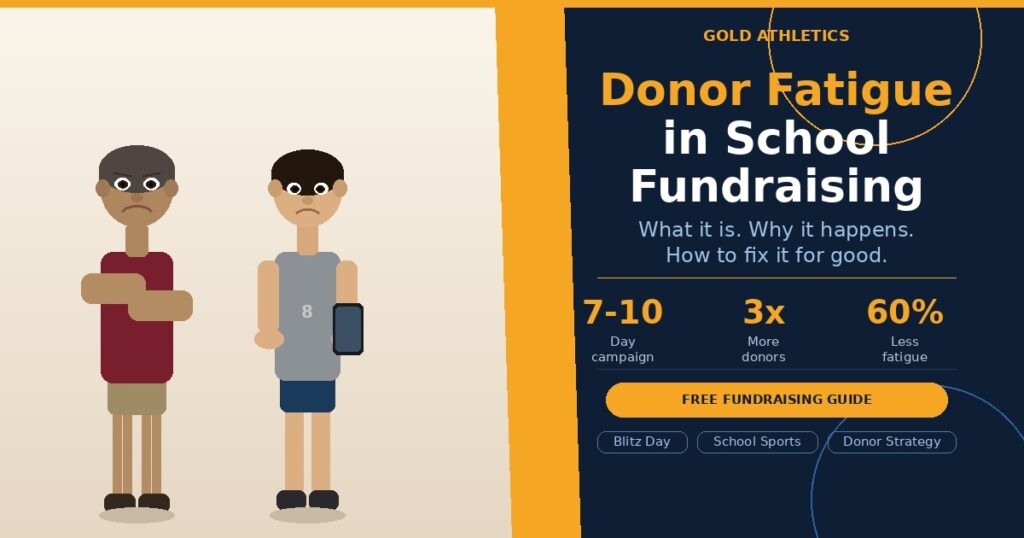
Quick Answer: Donor fatigue in school fundraising happens when supporters stop giving because they are asked too often with too little energy or purpose. The fix is not asking harder. Restructuring your campaign to be shorter, more focused, and backed by real on-site momentum is what actually works.
What Is Donor Fatigue in School Fundraising?
Donor fatigue in school fundraising is a condition in which parents, local businesses, and community supporters reduce or stop giving to school campaigns. It is not caused by a lack of generosity. It is caused by poor campaign structure, repetitive asks, and a lack of meaningful engagement.
According to fundraising research, donors who receive more than three asks in a short window are significantly less likely to give again in the same season. Because school sports programs often run multiple campaigns per year, donor fatigue compounds quickly and quietly.
Gold Athletics, a youth sports fundraising company that works with school programs across the United States, identifies donor fatigue as the leading cause of season-over-season fundraising decline in school athletic departments.
Why Does Donor Fatigue Hit School Sports Programs So Hard?
School programs operate in a uniquely crowded fundraising environment. In a single school year, the same parent or local business may receive donation requests from multiple teams and organizations simultaneously.
A typical donor in a mid-size school community may be approached by:
Football, cheer, band, wrestling, and softball teams
The school PTO and booster club
Charity 5K events and community drives
A coworker’s child’s travel team
Another booster club from a nearby school
Because most of those requests look identical, donors cannot distinguish one campaign from another. As a result, they begin ignoring all of them. This phenomenon is well documented in nonprofit fundraising research and applies directly to school athletic programs.
Beyond donor overwhelm, coaches and athletic directors are stretched thin. Fundraising becomes a last-minute push, then a slow drag, then a scramble at the end. Donors sense that disorganization even when the team is working hard. Additionally, when athletes are not fully bought in, they ask without confidence and skip follow-ups. The community notices immediately.
What Are the 5 Signs Your School Fundraiser Is Causing Donor Fatigue?
Recognizing donor fatigue early is essential to reversing it. Most programs show at least two of these warning signs before results begin declining significantly.
1. Response rates drop every season even with a bigger roster. More athletes should mean more reach. If totals are flat or falling despite roster growth, donors are tuning out rather than simply declining.
2. The same 20 supporters carry the entire campaign. Relying on a small group of consistent donors is not a sustainable fundraising model. It is borrowed time that erodes season after season.
3. Most donations arrive in the first 48 hours and then everything stalls. That early burst reflects goodwill from your core circle. The stall that follows is a classic indicator of donor fatigue and lost campaign momentum.
4. Athlete participation collapses after day three. Fewer contacts get added, fewer messages go out, and fewer follow-ups get completed. The fundraiser becomes background noise for the athletes who are supposed to drive it.
5. Supporters are giving the same responses repeatedly. “We just donated to the band.” “I keep getting links from different teams.” “I will catch you next season.” These responses signal that the campaign structure is the problem, not the community’s willingness to give.
What Should You Do When You Spot Donor Fatigue Warning Signs?
The answer is not to push harder or send more reminders. Instead, the solution is to restructure the fundraiser so it builds momentum naturally, feels organized, and gives people a genuine reason to engage right now.
Three immediate actions that reduce donor fatigue:
Shorten the campaign window to 7 to 10 days maximum
Replace passive digital asks with an on-site kickoff event
Limit donor contact to three intentional touchpoints throughout the campaign
Each of these changes reduces friction for donors while increasing urgency and energy for athletes.
Why Does Digital-Only Fundraising Make Donor Fatigue Worse?
Digital fundraising tools are valuable when used correctly. However, when digital becomes the entire strategy, donor fatigue accelerates rather than slows down.
Research on digital fundraising campaigns consistently shows that open rates, click rates, and donation activity drop sharply after the first week of a campaign. For school sports programs specifically, this pattern is exaggerated because:
Every ask feels identical. A text, a link, and a generic page look the same regardless of which team sends it.
All accountability falls on athletes and parents. Without coaching or live structure, participation becomes optional for busy teenagers.
Campaigns run too long. Two to four week campaigns feel like spam to donors who receive multiple asks per week.
There is no on-site emotional connection. People give more when they feel connected to a real moment, and a link sent on a Tuesday afternoon does not create that connection.
A school running a 30-day digital campaign with daily reminders will typically see donation activity drop by more than 60 percent after the first seven days. Therefore, length and channel alone are not enough. Structure and energy are what drive results.
What Is a Blitz Day and How Does It Prevent Donor Fatigue?
A Blitz Day is a high-energy, on-site kickoff event where coaches and fundraising representatives lead athletes through real-time campaign participation together. Phones are out, scripts are ready, and everyone takes action at the same time.
Why Blitz Day outperforms digital-only launches:
Immediate buy-in: athletes see teammates taking action and follow immediately
Fast momentum: campaigns that start strong consistently finish strong
Confident asks: athletes receive live coaching on exactly what to say and how to say it
Reduced procrastination: the team launches together in real time rather than waiting for individual follow-through
Cleaner donor experience: donors receive one timely, confident ask tied to a real team push rather than five scattered reminders over three weeks
Gold Athletics uses the Blitz Day model as a core component of its school fundraising programs. By combining on-site kickoff energy with app-driven tracking, Gold Athletics keeps campaigns organized and momentum high well beyond launch day. From the donor’s perspective, the experience does not feel like being chased. It feels like a short, focused rally worth supporting.
How Should You Structure a School Fundraiser to Avoid Donor Fatigue?
The following framework is used by Gold Athletics across hundreds of school sports fundraising campaigns. It works across sports, band programs, and booster-led initiatives.
Step 1: Run short — 7 to 10 days, not 30. A focused window creates urgency and respects your community’s time. Long campaigns create more reminders, more guilt, and more avoidance.
Step 2: Open with a real on-site kickoff. Even a 30 to 45 minute kickoff event changes the entire trajectory of the campaign. A Blitz Day style push at launch sets the tone, communicates the purpose, and gets athletes taking action immediately.
Step 3: Give athletes a concrete daily standard. Measurable daily standards make participation coachable. Examples include: add 10 contacts today, send 10 texts and 5 emails, complete 5 follow-ups before practice. Clear standards remove ambiguity and drive consistent effort.
Step 4: Limit donor touches to three intentional moments.
Day 1: Initial ask with a clear purpose and specific goal
Day 4: One progress update showing momentum and gratitude
Day 7: Final push with a specific deadline and remaining gap
No daily reminders. No guilt messaging. Each touchpoint should tell donors what their support unlocks, not just that the campaign is still running.
Step 5: Add real value for donors. Gold Athletics builds merchant reward networks into its programs, giving donors access to local discounts and perks in exchange for their support. This transforms the transaction from another request into support plus tangible value. Donors who receive something in return are significantly more likely to give again the following season.
Step 6: Track participation publicly and positively. Action leaderboards that reward effort consistently outperform dollar-only leaderboards. When only the top earners are recognized, most of the roster disengages by day three. Action-based tracking keeps the full team motivated throughout the campaign.
What Fundraising Incentives Actually Motivate Student Athletes?
Athletes do not need larger prizes. They need rewards that feel immediate, fair, and tied to real effort.
Reward actions within the first 24 to 48 hours. Early habits shape the entire campaign. Celebrate quick wins such as the first 10 contacts entered, the first 10 messages sent, or the first donation received. Early momentum compounds through the final days.
Use team-based goals alongside individual ones. If only the top three earners receive prizes, most of the roster checks out by day three. Team goals are more effective. For example: if participation reaches 90 percent by Friday, the coach wears something memorable at the next game. Simple, energetic, and highly effective.
Combine recognition with tangible rewards. Public shoutouts, in-team acknowledgment, and visible effort recognition are powerful motivators. Make it normal to celebrate participation, not just dollar totals.
Add donor-friendly rewards through merchant networks. Merchant reward systems benefit athletes and donors simultaneously. Athletes have an easier ask because they are offering real value, and donors feel appreciated rather than pressured. Gold Athletics merchant reward network is one of the key differentiators that separates its programs from standard digital-only platforms.
Frequently Asked Questions
What is donor fatigue in school fundraising? Donor fatigue in school fundraising occurs when parents, local businesses, and community supporters stop giving because they receive too many repetitive, low-energy asks. It is caused by poor campaign structure and timing, not a lack of community generosity.
How do you prevent donor fatigue in a school sports fundraiser? Run a short 7 to 10 day campaign, open with a high-energy on-site kickoff, limit donor contact to three intentional touchpoints, and provide real value in return for support. Clear athlete standards and team-based goals also maintain participation throughout.
How long should a school fundraiser run to avoid donor burnout? Seven to 10 days is the optimal window for school sports fundraising. Campaigns longer than two weeks dramatically increase reminder fatigue on both the donor and athlete side, leading to declining participation and total dollars raised.
Why does digital-only fundraising increase donor fatigue? Digital-only platforms rely on repeated link sharing without on-site energy, coaching, or real accountability. Without a live kickoff and daily structure, campaigns drag on, athletes disengage, and donors feel targeted rather than connected to a meaningful cause.
What is a Blitz Day and how does it help with donor fatigue? A Blitz Day is a high-energy on-site kickoff event where athletes and coaches take action together in real time. It creates immediate buy-in, fast momentum, and confident asks. Programs using Blitz Day launches consistently outperform digital-only campaigns in both participation rates and total dollars raised.
How does Gold Athletics help schools reduce donor fatigue? Gold Athletics combines on-site Blitz Day coaching, app-driven athlete accountability, and a merchant rewards network into a single school fundraising program. This model keeps campaigns short, energetic, and valuable for donors, reducing fatigue and improving season-over-season fundraising results for school athletic departments across the United States.
Contains information related to marketing campaigns of the user. These are shared with Google AdWords / Google Ads when the Google Ads and Google Analytics accounts are linked together.
90 days
_gid
ID used to identify users for 24 hours after last activity
24 hours
__utma
ID used to identify users and sessions
2 years after last activity
_gat
Used to monitor number of Google Analytics server requests when using Google Tag Manager
1 minute
__utmt
Used to monitor number of Google Analytics server requests
10 minutes
__utmb
Used to distinguish new sessions and visits. This cookie is set when the GA.js javascript library is loaded and there is no existing __utmb cookie. The cookie is updated every time data is sent to the Google Analytics server.
30 minutes after last activity
__utmc
Used only with old Urchin versions of Google Analytics and not with GA.js. Was used to distinguish between new sessions and visits at the end of a session.
End of session (browser)
__utmz
Contains information about the traffic source or campaign that directed user to the website. The cookie is set when the GA.js javascript is loaded and updated when data is sent to the Google Anaytics server
6 months after last activity
__utmv
Contains custom information set by the web developer via the _setCustomVar method in Google Analytics. This cookie is updated every time new data is sent to the Google Analytics server.
2 years after last activity
__utmx
Used to determine whether a user is included in an A / B or Multivariate test.
18 months
_ga
ID used to identify users
2 years
_gali
Used by Google Analytics to determine which links on a page are being clicked