

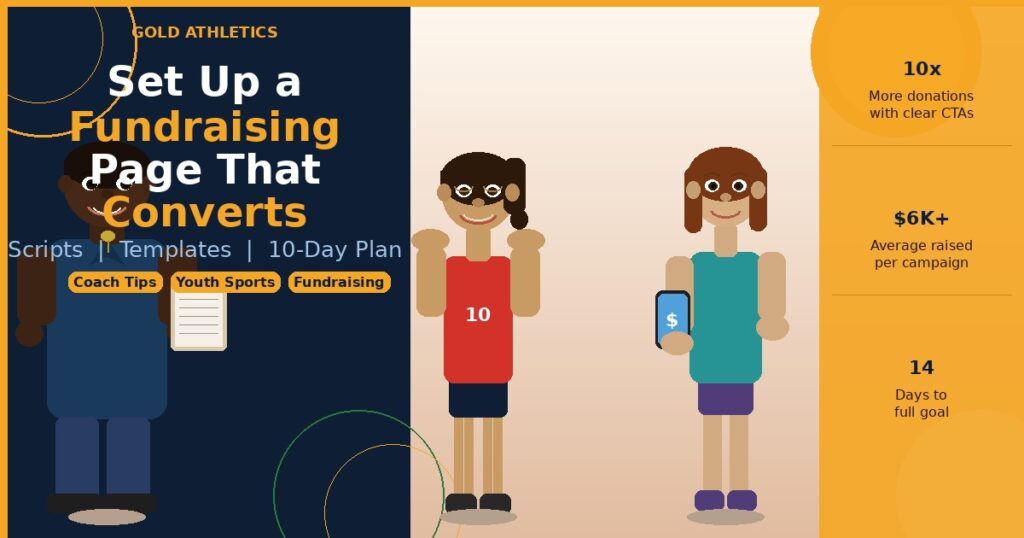
Quick Answer: Setting up a sports team fundraising page that converts visitors into donors is simpler than most teams think. Because most pages lose donations in the first 10 seconds, the difference between raising $800 and $8,000 comes down to three things: a clear headline, a donate button above the fold, and a simple breakdown of where the money goes.
Why Do Most Team Fundraising Pages Fail to Convert?
Most pages assume visitors already care as much as the organizer does. In reality, a new visitor lands with zero context, no urgency, and no obvious reason to give right now.
They see a wall of text, a vague goal, and a donate button buried at the bottom. As a result, they leave without donating.
A converting fundraising page does three things in seconds:
- Tells visitors exactly what the money is for
- Shows why it matters to the kids involved
- Makes donating feel simple and safe
How Do You Build a Sports Team Fundraising Page That Converts?
Use this layout from top to bottom. Because donors skim on their phones, every section needs to earn its place.
- Benefit-focused headline
- One sentence explaining what the funds cover
- Donate buttons with preset amounts (above the fold)
- One strong recent team photo
- Short story (5 to 8 lines)
- Bullet list showing where the money goes
- Progress bar toward goal
- Social proof: updates, supporter names, sponsor logos
- FAQ and contact information
- Final donate button at the bottom
You are not writing an essay. You are removing friction.
How Do You Write a Headline That Gets People to Donate?
Lead with impact, not the event name. Because vague headlines lose donors in seconds, your headline needs to answer: what happens for these kids if I give?
Skip this: “Support the Tigers 12U Fundraiser!”
Use this instead: “Help 12U Tigers Get to State Without Families Paying More”
Plug-and-play headline examples:
- “Send Our Girls Soccer Team to Nationals (Travel Costs Covered)”
- “New Safety Gear for 24 Youth Football Players”
- “Help Our Baseball Team Replace Worn-Out Equipment This Season”
- “Keep Youth Sports Affordable for Every Family on Our Team”
What Should You Write Directly Under the Headline?
One sentence. Make the ask specific and tied to a real number.
Examples:
- “We are raising $6,000 to cover tournament fees, travel, and uniforms for 14 athletes.”
- “Every $50 helps provide one athlete with updated safety equipment.”
- “Your donation helps us keep registration costs low so every kid can play.”
This line is where clarity wins donations.
Where Should the Donate Button Go on a Fundraising Page?
Above the fold. Always. On mobile, that means visible before any scrolling happens.
If your platform allows it, add a sticky donate button that stays visible as people scroll. Additionally, repeat the donate button two to three times throughout the page so donors never have to hunt for it.
What Donation Amounts Should You Offer?
Offer four to six preset amounts plus an “Other” option. Because tangible outcomes make donating feel meaningful, tie each amount to a real result.
| Amount | What It Covers |
|---|---|
| $25 | Practice supplies |
| $50 | One tournament entry portion |
| $100 | A uniform item or travel portion |
| $250 | One athlete’s full fees |
| $500 | A major team expense |
| Other | Custom amount |
If your fundraiser has a clear unit cost, use it. For example: “$85 covers one player’s full uniform package.”
What Photo Should You Use at the Top of a Fundraising Page?
Use one real, recent team photo. Avoid blurry old shots or polished studio images that look like ads.
The best photo has:
- Faces that are clearly visible
- Action or candid energy
- Coaches and kids who look engaged and motivated
A second image lower on the page works well too. However, make sure it reinforces purpose such as travel, new gear, a tournament moment, or community service.
How Long Should Your Story Section Be?
Short. Emotional. Specific. Aim for five to eight lines written the way you would text a supportive parent.
Use this fill-in template:
“Our team is working hard this season and we have earned the chance to compete at [event/level]. To get there, we need help covering [travel/fees/uniforms/equipment] so families are not forced to shoulder the full cost. Every donation goes directly to [what it funds] and helps keep youth sports affordable and accessible for our athletes. If you can give, thank you. If you can share, that helps just as much.”
How Do You Show Where the Money Goes Without Sounding Defensive?
Be transparent, not apologetic. Add a simple “Funds will be used for” bullet list so donors can see exactly where their money is going.
Example breakdown:
- Tournament and league fees: $2,200
- Travel including gas, hotel, and team meals: $2,600
- Uniforms and gear replacements: $900
- Scholarship support for families who need it: $300
If you do not have exact numbers, estimate and label it clearly. Because trust is a direct conversion lever, showing a breakdown reduces skepticism and speeds up donations.
Should You Show a Goal Amount and Progress Bar?
Yes, almost always. Goals create momentum, and progress bars create positive social pressure.
One important rule: tie your goal to real costs, not a round number that sounds impressive.
Strong goal: “Goal: $6,000 to cover 3 tournaments plus travel” Weak goal: “Goal: $10,000”
If you are already partway there, say so: “We are already at $2,150. Help us close the gap.”
What Updates Should You Post to Increase Fundraising Page Conversions?
Updates are conversion fuel. Most teams post once and then go silent, and as a result donors assume the campaign is over or poorly organized.
Post at least two updates per week during the active push. Strong update ideas include:
- “We just hit 30% of our goal. Thank you!”
- A short clip or photo from practice with a thank you message
- A sponsor spotlight featuring a local business that gave
- A milestone update: “We just paid our first tournament entry fee”
- A deadline reminder: “Registration is due this Friday”
Every update should end with: “Donate if you can. Share if you cannot.”
How Do You Drive Traffic to a Sports Team Fundraising Page?
Use a structured 10-day push instead of random posting. Because direct messages convert better than broad social posts, prioritize texts and personal outreach first.
10-day outreach plan:
- Day 1: Parents and inner circle to build early momentum
- Day 2: Team social media post and stories
- Day 3: Text message to extended family lists
- Day 4: Sponsor outreach to local businesses
- Day 5: Update post showing progress and gratitude
- Day 6: Player-led shares (each athlete texts 10 people)
- Day 7: “72 hours left” reminder with a specific need
- Day 8: Update post with a photo from practice
- Day 9: “24 hours left” final push
- Day 10: Final day strong CTA plus gratitude post
What Should Your Outreach Text Message Say?
Keep it personal and short. Because a text feels direct and human, it consistently outperforms social media posts.
Parent to family script: “Hey! Quick favor. [Child’s name]’s team is raising money to help cover [travel/fees/uniforms] this season. Here is the link: [link]. If you can donate, thank you. If not, sharing helps a lot.”
Coach or booster to community script: “Hi [Name], we are fundraising for [team name] to cover [specific costs] and keep the season affordable for our athletes. Would you consider a donation or sponsorship? Here is the page: [link]. Thank you for supporting youth sports.”
How Do You Add a Business Sponsorship Section to Your Fundraising Page?
Add a small, clear section for local businesses. Because businesses need clarity and visibility to say yes, keep the options simple.
Example sponsorship tiers for your page:
- $250: Name listed as a community supporter
- $500: Logo in the sponsor section plus a social media shoutout
- $1,000: Top sponsor mention in updates plus team banner credit
Include a direct email or phone number so businesses can reach out quickly.
How Do You Fix Your Sports Team Fundraising Page Today?
If your page is already live but underperforming, make these three changes today:
- Rewrite the headline to focus on outcomes for kids
- Move the donate button and preset amounts above the fold
- Add a clear “Funds will be used for” bullet list
Those three changes alone typically improve results without rebuilding anything else.
What Should You Avoid on a Sports Team Fundraising Page?
Even though some of these mistakes feel harmless, they consistently kill conversions:
- Long paragraphs with no subheadings
- Multiple competing asks on the same page (donate, buy merch, sign up, volunteer)
- Generic statements like “any amount helps” with no context
- A donate button only at the very bottom
- No deadline, no updates, and no sense of momentum
- Stock photos or overly polished graphics that feel impersonal
Simple and real always beats fancy.
Frequently Asked Questions
How long should a team fundraiser run? Ten to fourteen days is the sweet spot for urgency. Longer campaigns lose momentum unless you have frequent updates and multiple outreach pushes throughout.
What is a realistic fundraising goal for a youth sports team? Base it on actual costs. A simple estimate is the number of families involved multiplied by ten to twenty potential donors each, with an average gift of $25 to $75.
Should athletes be the ones sharing the fundraising page link? Yes, with supervision. Player-led asks often outperform team social posts because they feel personal. Give each athlete a short script and a clear target such as “send this to ten people.”
Is it better to focus on small donations or a few large ones? Both, but start with larger gifts first. Secure a few $250 to $1,000 sponsors early, then open the campaign to the broader community for smaller gifts.
How often should we post updates to the fundraising page? At least twice per week, and more frequently during the final 72 hours. A quiet page looks abandoned and converts poorly.
What if donors worry about where the money goes? Add a simple cost breakdown, post updates when you pay key expenses, and include a contact person for questions. Because trust is a direct conversion lever, transparency almost always increases giving.